Twenty years ago, I xeroxed some probate records in Salt Lake City, brought them home to Houston, and dutifully transcribed them. (Yes, before the availability of original records on the internet this was how we did it!)
The records pertained to several members of the Busbey/Busby family, some of whom are ancestors of mine through my grandmother Julia Evelyn Busbey Chadock Schoof (1894-1981). It is always nice to find a will spelling out relationships. However, a will captures that information at one point in time when the will was written, often years before the testator dies. In contrast, other probate records, even if a person died intestate, usually highlight facts over an extended period. Some of the facts arise from the time before the person died, others relate to the time of death, and still others occurred after death. The settlement account of Samuel Busby is a good example of this with facts relating to the past, present, and future.
Samuel Busby was one of six sons and one daughter named in the 1808 will of their father John Busby.[1] Samuel inherited his father’s plantation and a small adjoining tract. His inheritance was subject to his mother’s right during her life to one third of the plantation. His right to the land required further that Samuel pay his brothers Benjamin and Hamilton each $60 when they reached the age of twenty-one. Samuel and his younger brothers also shared equally the residue of their father’s personal estate. As executor, Samuel was in charge of distributing those funds.
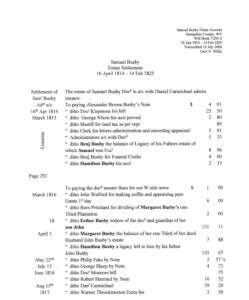
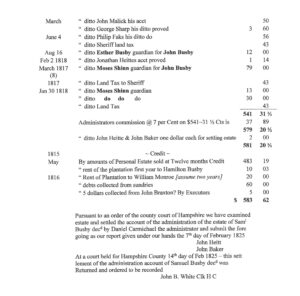
In 1813, Samuel married Esther Shinn.[2] He died without a will shortly afterwards in early 1814. The settlement of Samuel’s personal estate contains entries from 1814 through its final filing with the court in 1825.[3] Those entries provide a number of facts about Samuel and his family and clues about where to look for more.
The Past
Several entries in the settlement account relate to Samuel’s inheritance from his father. In 1815, Samuel’s estate paid the balance of the amount he owed to his brothers under their father’s will. This indicates both brothers had attained adulthood. This can be confirmed by reference to the 1810 federal census that showed three males ages 16-26 in Samuel’s household.[4] Five years later, the youngest of the three would have been twenty-one.
In 1816, other entries record payment to Margaret, Samuel’s mother, for her interest in one third of the plantation. Clearly, she was still alive at that point. While Samuel’s land was not part of his personal estate, income derived from it was and needed to be accounted for in the settlement.
One entry records payment of a fine Samuel incurred for not appearing at muster with his sidearm. Apparently, Samuel had been in a local militia unit, and he failed to appear as required for a periodic drill.
The Present
The settlement document establishes several things at the time of Samuel’s death. For example, Samuel’s estate paid $25.50 to the doctor who cared for him. Based on what I have seen elsewhere, this seems a significant sum. Thus, Samuel likely received medical care for some amount of time rather than dying suddenly.
In 1816, the estate paid Samuel’s wife Esther $131.11 “as the widow and the guardian of her son John.”[5] Evidently, Esther had been pregnant at the time of Samuel’s death. Their son John Hamilton Busbey was born 28 Jun 1814.[6]
Young John and the widow Esther were the only heirs to Samuel’s estate. Since Samuel died intestate, John inherited the real property with Esther having a life estate in one third of it. The inherited land, however, remained encumbered by Samuel’s mother Margaret’s life estate as long as she was alive. As to Samuel’s personal property, the widow Esther was entitled to one third outright after payment of all debts. Further, as John’s guardian, she had control for his benefit of the remainder of Samuel’s personal property.
The Future
The estate paid Esther one more payment as guardian of her son John. In 1817 and 1818, however, the estate paid guardian fees to a Moses Shinn instead of Esther. This change suggests several possibilities. Esther might have died. Or she might have deemed herself incapable of continuing as guardian and the guardianship passed to a relative, Moses Shinn. Or it might be that she married Moses Shinn. In fact, the latter was the case. Esther and Moses married 13 Feb 1817 in Harrison County.[7] The two were first cousins; Esther being the daughter of David Shinn and Moses the son of David’s brother Levi.[8]
Samuel’s estate settlement establishes the approximate date of his mother Margaret’s death. As long as she lived, the estate tracked income and expenses related to the plantation and paid her share. After 1817 the estate did not share any proceeds from the plantation with Margaret. Nor did the estate account for further rental income or taxes paid on the land. Together, this indicates she had died, likely about 1817. With her passing, the land fell in fee to Samuel’s heirs, John and his mother, with no further accounting required by Samuel’s estate. As John’s legal guardian and Esther’s husband, Moses Shinn controlled the property.
It is worth noting that the settlement was not closed out and filed with the court until 1825, eleven years after Samuel’s death. Sometimes the reason for such a delay is the estate’s holding some asset encumbered by divergent claims. In this case, that asset was the plantation. If the land were sold during Esther’s lifetime, her life estate required that she participate in the sale, and the administrator would track the division of proceeds. She died in 1823. That left young John as the sole heir with his stepfather as guardian and cleared the estate administration to be closed.[9]
Later Facts
Those are the only facts and clues we can derive from Samuel’s estate settlement. (Attached below is my transcription). Looking further down the road, we find Moses soon remarried. John, therefore, grew up with two step parents and three step siblings, the children of Moses and Esther. We can surmise that Moses faithfully took care of the land for his stepson. When John reached maturity, he sold the plantation before migrating to Louisiana where he raised a family.[10]
_______
[1] Will of John Busby dated 12 Mar 1808, filed for probate 9 Nov 1810, Will Book 5:178-180, Hampshire County, Virginia (now West Virginia) transcribed 3 Jul 2006 by Gary N. Willis, naming wife Margaret and children Elizabeth Meredith, William Busby, Matthew Busby, John Busby, Samuel Busby, Benjamin Busby, and Hamilton Busby.
[2] Findagrave.com references a Shinn family history noting her marriage 9 Dec 1813 after which she was disowned by her Quaker religion for marrying outside the discipline.
[3] Estate Settlement of Samuel Busby by Daniel Carmichael, administrator, with entries dating from 16 Apr 1814 through filing on 7 Feb 1825, Will Book 7:291-2, Hampshire County, Virginia (now West Virginia) transcribed 17 Jul 2006 by Gary N. Willis.
[4] 1810 Federal Census for Hampshire County, Virginia (now West Virginia).
[5] The amount probably included her “one-thirds” of the personal estate plus some amount for support of the child.
[6] Findagrave.com tombstone of John Hamilton Busbey, Oakland Cemetery, Shreveport, Caddo Parish, Louisiana, born 28 Jun 1814, died 30 Jun 1854.
[7] Cochran, Wes, Harrison County Marriages, 1785-1894, Parkersburg, West Virginia, 1985, p.42, Moses Shinn and Hester Busby
[8] Sage, Clara McCormick and Jones, Laura Sage, Early Records of Hampshire County, Virginia, Now West Virginia, Genealogical Publishing Co., Inc., Baltimore, MD, 1969, (originally published Delevan, Wisconsin, 1939), p. 133, 7 Mar 1815 Will of David Shinn names son-in -law Samuel Busby.
[9] Findagrave.com tombstone of Esther (Shinn/Busbey) Shinn, born 21 May 1793, died 14 Oct 1823, buried Pine Bluff Cemetery, Harrison County, West Virginia.
[10] Hampshire County, West Virginia Deed Book 31:243, on 1 Aug 1835 John H Busby sold 146 acres to Robert Carmichael for $225.