Rev. Adam Rankin of Lexington, KY (1755-1827), revised: Psalmody & other controversies

Rev. Adam Rankin of Lexington, Fayette County, Kentucky is the source of some fun Rankin family history issues. He also caused considerable controversy in his denomination during his lifetime. Genealogical questions aside, Rev. Adam’s life is a story unto itself.

Here are the major issues about Rev. Adam:

    • What was Rev. Adam’s life all about? He is famous for stoking the flames of an uproar about an arcane theological issue. He was rabidly fanatic on the matter, and that may be an understatement.
    • Who were Rev. Adam’s parents? I have found no evidence of Rev. Adam’s family of origin in traditional primary sources such as county records – deeds, wills, tax lists, marriage records, and the like. Instead, there is only secondary evidence, usually deemed less reliable than primary evidence. In Rev. Adam’s case, however, the secondary sources are unusually credible.
    • What is the Y-DNA evidence about Rev. Adam’s line? Y-DNA testing establishes that Rev. Adam was a genetic relative of Adam and Mary Steele Alexander Rankin, as family tradition claims.

Rev. Adam’s theological mess

There is a wealth of evidence regarding Rev. Adam’s personality in history books. George W. Rankin’s 1872 History of Lexington describes Rev. Adam as a “talented, intolerant, eccentric, and pious man, [who] was greatly beloved by his congregation, which clung to him with devoted attachment through all his fortunes.”[1]

Even more colorfully, Rev. Robert Davidson’s 1847 history of Kentucky Presbyterianism says that Rev. Adam “appears to have been of a contentious, self-willed turn from his youth … and his wranglings at last ended in a schism. Obstinate and opinionated, his nature was a stranger to concession, and peace was to be bought only by coming over to his positions … his pugnacious propensities brought on at last a judicial investigation.”[2]

An early twentieth-century Kentucky history describes Rev. Adam as “a strange, eccentric man, a dreamer of dreams, a Kentucky Luther, and, perhaps, a bit crazed with the bitter opposition his views received.”[3]

What on earth do you suppose all the fuss was about?

Ahem. The theological issue about which Rev. Adam was fanatical is the so-called “Psalmody controversy.” Psalmody, said Rev. Davidson, was “his monomania.”

The what controversy? I have a friend who is a retired Presbyterian minister, and he has never heard of it.

An article titled “How Adam Rankin tried to stop Presbyterians from singing ‘Joy to the World’” describes the issue and its origins:

“In 1770 [sic, 1670], when Isaac Watts was 18 years of age, he criticized the hymns of the church in his English hometown of Southampton. In response to his son’s complaints, Watts’ father is reputed to have said, ‘If you don’t like the hymns we sing, then write a better one!’ To that Isaac replied, ‘I have.’ One of his hymns was shared with the church they attended and they asked the young man to write more.

For 222 Sundays, Isaac Watts prepared a new hymn for each Sunday, and single-handedly revolutionized the congregational singing habits of the English Churches of the time. In 1705, Watts published his first volume of original hymns and sacred poems. More followed. In 1719, he published his monumental work, ‘The Psalms of David, Imitated.’ Among those many familiar hymns is the Christmas favorite ‘Joy to the World,’ based on Psalm 98.

For many years, only Psalms were sung throughout the Presbyterian Churches and the old ‘Rouse’ versions were the standard. The first General Assembly of the Presbyterian Church in the United States convened at the Second Presbyterian Church in Philadelphia in 1789. One of the Prebyterian ministers of the time, a man by the name of Rev. Adam Rankin, rode horseback from his Kentucky parish to Philadelphia to plead with his fellow Presbyterians to reject the use of Watts’ hymms.[4]

Rev. Adam had to be a virtual lunatic on the issue to ride more than 600 miles from Lexington to Philadelphia, right? Assuming the Reverend’s horse was capable of 12-hour days at an average speed of four miles per hour, that’s a good 12-day trip each way.[5] And we must surely assume that Rev. Adam rested on the Sabbath.

The trip is even more extraordinary because Rev. Adam had no “commission” to attend the Assembly, meaning he was not an official attendee.[6] He simply requested to be heard by the Assembly on the subject of Psalmody. Specifically, he sought a repeal of a 1787 resolution allowing Watts’ hymns to be used in churches. Rev. Adam presented this query to the General Assembly:

“Whether the churches under the care of the General Assembly, have not, by the countenance and allowance of the late Synod of New York and Philadelphia, fallen into a great and pernicious error in the public worship of God, by disusing Rouse’s versification of David’s Psalms, and adopting in the room of it, Watts’ imitation?”[7]

The Assembly listened to him patiently. Then it urged (gently, it seems to me) Rev. Adam to behave in a similar fashion by extending “that exercise of Christian charity, towards those who differ from him in their views of this matter, which is exercised toward himself: and that he be carefully guarded against disturbing the peace of the church on this head.”[8]

You can probably guess how well Rev. Adam followed that advice:

“No sooner had he returned home than he began to denounce the Presbyterian clergy as Deists, blasphemers, and rejecters of revelation, and debarred from the Lord’s Table all admirers of Watts’ Psalms, which he castigated as rivals of the Word of God.”[9]

Emphasis added. “Debarred from the Lord’s Table” means that Rev. Adam refused to administer communion to parishioners who disagreed with him about Watts’ hymns. It is hard to imagine a more radical punishment in a Presbyterian church short of, I don’t know, burning dissenters at the stake.[10]

Rev. Adam didn’t mince words. He verbally abused his Psalmody opponents in ways that would make even some partisan politicians cringe. He called them weak, ignorant, envious, and profane, compared them to swine, said they bore the mark of the beast and that they were sacrilegious robbers, hypocrites, and blasphemers. It makes Newt Gingritch’s instruction to his House colleagues circa 1986 to call members of the opposing party “traitors” and the “enemy” seem almost collegial by comparison.

In 1789, several formal charges were brought against Rev. Rankin before the Presbytery to which his church belonged. One charge was that he had refused communion to persons who approved Watts’ psalmody. Apparently attempting to dodge a trial, he made a two-year trip to London. When he returned, his views unchanged, his case was tried in April 1792. Rev. Adam just withdrew from the Presbytery, taking with him a majority of his congregation.[11]

He then affiliated with the Associate Reformed Church, although the honeymoon was brief. Rev. Davidson wrote that Rev. Adam “was on no better terms with the Associate Reformed than he had been with the Presbyterians; and his pugnacious propensities brought on at last a judicial investigation.” In 1818, he was suspended from the ministry. He and his congregation simply declared themselves independent.

Rev. Adam wasn’t merely stubborn and pugnacious. He may also have been somewhat deluded. He claimed early on that he was guided by dreams and visions, convinced that “God had raised him up as a special instrument to reinstate ‘the Lord’s song.’” Eventually, he was led by a dream to believe that “Jerusalem was about to be rebuilt and that he must hurry there in order to assist in the rebuilding. He bade his Lexington flock farewell, and started to the Holy City, but, on November 25, 1827, death overtook him at Philadelphia.”[12]

I find myself wishing he had made it to Jerusalem just to see what happened. Of course, there is no telling what additional trouble we might now have in the Middle East if he had done so.

Rev. Adam’s widow moved to Maury County, Tennessee along with her sons Samuel and Adam Rankin Jr.  She died there. Her tombstone in the Greenwood Cemetery in Columbia reads simply “Martha Rankin, consort of A. Rankin of Lexington, KY.”[13] It was probably no picnic, being a planet in Rev. Adam’s solar system.

Moving on to the next issue …

Who were Rev. Adam’s parents?

As noted, there appears to be no primary evidence available on Rev. Adam’s family of origin. The family oral tradition is that he was a son of Jeremiah and Rhoda Craig Rankin of Cumberland County, Pennsylvania. Jeremiah, in turn, was one of the three proved sons of the Adam Rankin who died in 1747 in Lancaster County, Pennsylvania and his wife Mary Steele Alexander Rankin.

Family tradition also says that Jeremiah died young in a mill accident. There are no probate records in the Rankin name concerning his estate in Cumberland County, so far as I have found. There should be, because he owned land inherited from his father. Likewise, I haven’t found any guardian’s records in Cumberland, although Jeremiah’s children were underage when he died. In fact, the only reference I have found to Adam’s son Jeremiah in county records is Adam’s 1747 Lancaster County will.[14] I may have missed something. It wouldn’t be the first time. Or perhaps the records no longer exist.

Fortunately, there are at least two pieces of credible secondary evidence about this family: (1) Rev. Robert Davidson’s History of the Presbyterian Church in the State of Kentucky and (2) oral tradition preserved in an 1854 letter written by one of Rev. Adam’s sons. Both provide evidence concerning Rev. Adam’s family of origin.

Here is what Rev. Davidson wrote about Rev. Adam (boldface and italics added).

“The Rev. Adam Rankin was born March 24, 1755, near Greencastle, Western Pennsylvania [sic, Greencastle is in south-central Pennsylvania]. He was descended from pious Presbyterian ancestors, who had emigrated from Scotland, making a short sojourn in Ireland by the way. His mother, who was a godly woman, was a Craig, and one of her ancestors suffered martyrdom, in Scotland, for the truth. That ancestor, of the name of Alexander, and a number of others, were thrown into prison, where they were slaughtered, without trial, by a mob of ferocious assassins, till the blood ran ancle [sic] deep. This account Mr. Rankin received from his mother’s lips. His father was an uncommon instance of early piety, and because the minister scrupled to admit one so young, being only in the tenth year of his age, he was examined before a presbytery. From the moment of his son Adam’s birth, he dedicated him to the ministry. He was killed in his own mill, when Adam, his eldest son, was in his fifth year. [Rev. Adam] graduated at Liberty Hall [now Washington & Lee University], about 1780. Two years after, Oct. 25, 1782, at the age of twenty-seven, he was licensed by Hanover Presbytery, and, about the same time, married Martha, daughter of Alexander McPheeters, of Augusta county.”[15]

Perhaps the most important thing Rev. Davidson said about Rev. Adam was in a footnote: “This sketch of Mr. Rankin’s early history so far is derived from his autobiography, prepared, shortly before his decease, for his friend, Gen. Robert B. McAfee, then Lieut. Governor of the State.” That qualifies as information straight from the horse’s mouth, so to speak.[16] Several facts stand out in Rev. Davidson’s sketch:

    • The death of Rev. Adam’s father in a mill accident confirms the family oral tradition. The date is established at about 1760-61, when Rev. Adam was in his fifth year.[17]
    • Adam’s mother was, as the family history says, a Craig.[18]
    • There was a Presbyterian martyr among Rev. Adam’s ancestors, although the murdered man was his mother’s ancestor, not his father’s. The oral family history in this branch of the Rankin family identifies the pious Scots ancestor as Alexander Rankin, two of whose sons were reportedly martyred before the survivors escaped to Ulster. The failure of Rev. Adam’s autobiography to reference that legend suggests he probably never heard it.
    • Adam was born in Greencastle, Cumberland County, Pennsylvania. That county was created in 1750 from Lancaster, where Adam and Mary Steele Alexander Rankin lived. Adam and Mary’s sons William and James began appearing in Cumberland in the 1750s. Rev. Adam’s birth in Greencastle is consequently good circumstantial evidence that he was from the family of Adam and Mary Steele Rankin.

The other significant piece of evidence regarding Rev. Adam’s family is an 1854 letter written by John Mason Rankin, Rev. Adam’s youngest son.[19] It has copious genealogical information about John Mason’s siblings, nieces and nephews, and extended family. John Mason obviously wrote from personal knowledge as to his father’s generation and their children, all of whom lived in Fayette and Woodford Counties, Kentucky. He  also had information from the family’s oral tradition regarding the family’s earlier ancestry. Most importantly, his mother also lived with him near the end of her life. I would bet that she was an impeccable source of information about her family.

The original of John Mason Rankin’s letter is supposedly in the custody of a museum in San Augustine, Texas. Gary and I visited there in 2024, and the museum custodian had never heard of such a letter and didn’t know where it might be located. Fortunately, there is a lovely little library in San Augustine which features a genealogical section and an extremely helpful librarian. She had a Rankin file including xerox copies of the 1854 letter, as well as a less significant letter written earlier.

There are a couple of interesting things about the 1854 letter, in addition to the wealth of genealogical detail. First, it has some important information that is contradicted by John Mason Rankin’s Bible. Second, there are some minor and unsurprising errors.

First, John Mason identified the original immigrants in his Rankin family as the brothers Adam (his ancestor), John, and Hugh. This precisely echoes information contained on the famous bronze table in the Mt. Horeb Presbyterian Cemetery in Jefferson County, Tennessee. The tablet has a colorful story about the Rankin family in Scotland and Ireland that is worth reading.[20]

The Mt. Horeb tablet also identifies the family’s original Rankin immigrants as the brothers Adam, John and Hugh, and names Adam’s wife Mary Steele. That makes it certain that John Mason Rankin and the Mt. Horeb tablet were dealing with the same immigrant family. John Mason says he descends from Adam and Mary Steele Rankin. The Mt. Horeb Rankins descend from the John Rankin who died in 1749 in Lancaster. John was reportedly Adam’s brother according to both family traditions. Y-DNA testing has disproved that theory: Adam and John were NOT genetic kin.

The John Mason and Mt. Horeb tablet legends diverge prior to the Rankin immigrant brothers, however. John Mason’s letter does not include the colorful stories of Alexander Rankin and his sons in Scotland and Ireland. That part of the Mt. Horeb legend was apparently also omitted from Rev. Adam’s autobiography, or Rev. Davidson would surely have mentioned it. This creates an inference that the Mt. Horeb legend about the Killing Times in Scotland and the Siege of Londonderry in Ireland may not have been a part of Rev. Adam’s family’s oral history. That is my own belief.

In the interest of full disclosure, here are some minor errors or discrepancies in John Mason’s 1854 letter:

    • Adam Rankin (wife Mary Steele Alexander) died in 1747, not 1750.
    • John Mason identified the father of the three immigrant Rankins (John, Adam, and Hugh, allegedly brothers) as Adam. The Mt. Horeb tablet identifies the three men’s father as William. John Mason Rankin’s Bible also identifies the three men’s father as William. So far as I know, there is no evidence regarding the identity of either Adam’s or John’s father. The owner of the Bible, however, believes the information in the Bible is correct — the immigrant Adam’s father was named William — and that John Mason Rankin simply erred in the 1854 letter. For a variety of reasons, I agree.
    • What John Mason called “Cannegogy Creek” usually appears in the colonial records as “Conogogheague” Creek. In later records, it is spelled “Conococheague.” In any event, John Mason was clearly talking about the creek where Jeremiah’s mill was located. Two Presbyterian churches on or near that creek are the churches attended by Adam and Mary Steele Rankin’s sons William and James. That puts the three proved sons of Adam – James, William, and Jeremiah – in close geographic proximity, a nice piece of circumstantial evidence supporting their family relationship.
    • Jeremiah Rankin, Rev. Adam’s brother, had four sons, not three: Adam, Joseph, Andrew, and Samuel.

And that brings us to the last issue …

Y-DNA evidence concerning Rev. Adam’s line

A male descendant of Rev. Adam Rankin – a son of Adam and Mary Steele Rankin’s son Jeremiah – has Y-DNA tested and is a participant in the Rankin project. He is a 67-marker match with a genetic distance of 5 to a man who is descended from Adam and Mary Steele Rankin’s son William. That isn’t a particularly close Y-DNA match. Their paper trails nonetheless indicate with a high degree of confidence that Adam of Lancaster County is their common Rankin ancestor. Their Big Y results confirm it.

Six proved descendants of the John Rankin who died in 1749 in Lancaster have also Y-DNA tested and participate in the Rankin DNA project. They are a close genetic match to each other, and their paper trails are solid.

Here’s the rub. The six descendants of John are not a genetic match with the two descendants of Adam. Unless some other explanation can be found, the mismatch means that John and Adam did not have the same father. Let’s hope that more research and/or Y-DNA testing will shed further light on the issue.

One more thing: I posted an article about the John Mason Rankin letters after our trip to San Augustine. See it here.

And that’s all the news that’s fit to print. See you on down the road.

Robin

*   *   *   *   *   *   *

[1] George W. Rankin, History of Lexington, Kentucky (Cincinnati: Robert Clarke & Co., 1872) 108-110.

[2] Rev. Robert Davidson, History of the Presbyterian Church in the State of Kentucky (New York: R. Carter, 1847) 95. For “The Rankin Schism,” see p. 88 et seq. The book is available online  here.

[3] John Wilson Townsend and Dorothy Edwards Townsend, Kentucky in American Letters (Cedar Rapids, IA: The Torch Press, 1913) 17.

[4] Staff of the Ebenezer Presbyterian Church, March 20, 2015, “How Adam Rankin Tried to Stop Presbyterians From Singing ‘Joy to the World,’ published by The Aquila Report  at this url.

[5] Average horse speed stats are available at this website.  Estimated distance is from Google maps. I would bet the one-way trip took more than 12 days.

[6] Davidson, History of the Presbytrian Church 82.

[7] Ernest Trice Thompson, Presbyterians in the South, Volume One: 1607-1861 (Richmond: John Knox Press, 1963) 115-116.

[8] Id. at 218-219.

[9] Id.

[10] I was baptized and confirmed in, and currently belong to, a Presbyterian church. I am, after all, a Scots-Irish Rankin. My church’s motto is “ALL ARE WELCOME.” That phrase has several layers of meaning in this era of immigrant hatred, but its most fundamental meaning is that everyone is invited to participate in communion.

[11] Rankin, History of Lexington, Kentucky 108-110.

[12] Townsend, Kentucky in American Letters 17.

[13] Fred Lee Hawkins Jr., Maury County, Tennessee Cemeteries with Genealogical and Historical Notes, Vols. 1 and 2 (1989).

[14] Lancaster Co., PA Will Book J: 208, will of Adam Rankin dated 4 May 1747, proved 21 Sep 1747. Adam devised land to his sons James, Adam, and Jeremiah.

[15] Davidson, History of the Presbyterian Church in the State of Kentucky 95. Chapter III of the book is titled “The Rankin Schism,” 88 et seq. The book is available online  as a pdf, accessed 30 Aug 2018.

[16] I’m looking for that autobiography. No luck so far.

[17] I said Rev. Adam’s father died “about” 1760-61 simply because of the difficulty a 70-year-old man would naturally have pinpointing the exact time something happened when he was a child. Also, Rev. Davidson said that Rev. Adam “was in his fifth year.” I’m not sure whether tthat means he was four going on five, or five going on six.

[18] Rev. Davidson may have been more impressed by the Craig connection than the Rankin name on account of Rev. John Craig, a famous Presbyterian minister from Ireland who lived in Augusta Co., VA. See, e.g., Katharine L. Brown, “John Craig (1709–1774),” Dictionary of Virginia Biography, Library of Virginia, published 2006 available online here.

[19] You can find a transcription of the 1854 letter at this link.

[20] See a transcription of the Mt. Horeb tablet in Chapter 4 here.


Where are you from? Here’s a great source for Anglo names …

A couple of decades ago, my first cousin Butch Rankin[1] posed this question to me: “where are we from, anyway?” He didn’t specify which of our many shared ancestral lines he meant, but he was clearly asking about Rankins.

Hmmmm… there were some Rankins who came to the colonies from England, often Quakers. For example, there was a James Rankin in York Co., Pennsylvania in the 1770s, a Tory, whose estate was confiscated and who fled back to England.[2] But the vast majority of Rankin immigrants to the colonies during the 18th century came from Ireland. They were overwhelmingly Scots-Irish, Presbyterian, and Patriots.

Sometimes, names, locations and religion can reveal a great deal, and this is a good example. Butch’s and my earliest known Rankin ancestor first appeared in colonial records in Rowan County, North Carolina, smack dab in the middle of the Scots-Irish settlements of the Piedmont Plateau. Moreover, our ancestor Samuel Rankin – known as  Old One-Eyed Sam  – married  Eleanor (“Ellen”) Alexander. As nearly as I can tell, “Alexander” is the Scots-Irish equivalent of “Smith.” Samuel and Eleanor are buried in the Old Goshen Grove Presbyterian Church Cemetery in Belmont, NC. There was once a marker on the wall of Goshen Cemetery “in memory of the following Revolutionary soldiers,” including Robert Alexander (Eleanor Alexander Rankin’s brother), William Rankin (eldest son of Samuel and Eleanor), and Samuel Rankin  – Old One-Eyed Sam himself, who was too old to fight, but who was deemed a “patriot” by the DAR because he contributed supplies.[3]

OK, Scots-Irish, Presbyterian, and patriot: check, check, check. The correct answer to Butch’s question is that we came to the colonies from the province of Ulster in northernmost Ireland. And before our Rankin ancestors migrated to Ulster, they lived in Scotland.

But where in Scotland? I’ve done no research there because I hadn’t a clue where to start. Many Rankin researchers claim the highlands of northwest Scotland, reciting a frequently reported connection between the Rankins and the Maclean Clan of Duart Castle on the Isle of Mull. It is a popular story, although I’ve never seen a reference to evidence in any records. However, I never found a credible alternative opinion on the issue.

Until this week. There is a book at Clayton Genealogical Library that is new to me: The Oxford Dictionary of Family Names in Britain and Ireland, published by the Oxford University Press.[4] If you have Anglo ancestors, you might want to check this source, because it has some interesting information. Also, Oxford University has a certain aura of credibility.

This is what the Dictionary says about Rankin, in part (emphasis added):

“Rankin. Variants: Rankine, Ranken, Ranking

Current frequencies: GB 6341, Ireland 1281. GB frequency 1881: 4297

Main GB location 1881: widespread in Scotland and England, chiefly SW Scotland; Lancs; Northumb

Main Irish location 1847-64: Ulster: esp.Derry, Donegal, and Antrim    

Scottish, English: relationship name from Middle English Ran(d)kin, a diminutive of Ran(d), a pet form of the personal name Ran(d)ulf. See Rand, Randolph, Randall.

Further information: this name was brought to Northern Ireland (Derry) from Scotland in the 17thcentury.

Early bearers: given names: Rankin de Fowlartoun, 1429 in Ayr Charters (Ayr, Ayrs).”

I’m a bit foggy about what “Ayr Charters” are, although this article is helpful.  But I am quite clear about the counties Derry, Donegal and Antrim in the province of Ulster, Ireland, to which many Scots migrated during the 1610-1690 period. (See a map of Irish provinces and counties comprising them  here). Google Maps is also unambiguous about Ayr, a city on the Firth of Clyde in the province of Ayrshire in southwest Scotland. As the crow flies, Ayr to Londonderry (or Derry, depending on your politics)  in Northern Ireland is about 120 miles. Just for fun, there is a Rankintown about 12 miles southeast of Ayr.

Based on just the numbers, there is a decent chance that your Scots-Irish Rankin ancestor lived in Ayrshire, Scotland before migrating to Derry, Donegal or Antrim county in the province of Ulster  – and then arriving in the Colonies during the “Great Migration” of the 18th century. I like the odds.

To check the Dictionary’s source for identifying “Rankin de Fowlartoun” as a resident of Ayr in 1429, just Google “Ayr Charters.” You will find a mind-boggling text in both Latin and English. The document says it is the full text of “Charters of the royal burgh of Ayr.”

The relevant text in Latin is described in the heading as a “Notarial Instrument concerning the Rendering of Accounts by the Bailies of Ayr,” dated 17 November 1429. It’s been more than half a century since I wrestled with Virgil’s Aeneid, so the only things I recognize are dates and names. The latter includes “Johannes de Bathcate” and “Thomas de Carrie,” who were the “bailies” (Bailiffs? Sheriffs? Tax collectors?) of the Burgh of Ayr.

The other Latinized names in the text include Henrico Forrestar (Henry Forrest or Forrester, the Chamberlain’s deputy), Rankino de Fowlartoun, Alexandro de Cragy, Thoma[s] Crotteche, David Glassynwricht, Macolmo de Qulchone, Johanne Litster, Johanne Gray, Johanne Bannezour, Gilberto Askirk, and Thomas Hakete, the notary.

Fortunately, there is an abstract of the Latin text at the same link, although it omits all names except for the two bailies and the Chamberlain’s deputy. Here is what it says, in part:[5]

“Notarial Instrument narrating that John of Bathgate and Thomas of Carrick, bailies of Ayr, being charged to render their account for the past year by Henry Forestar, depute of the chamberlain, in the manner and form contained in a certain instrument accepted by the said depute;

They having advised with the best men of the burgh of Ayr declared that they were never before the past year charged or required to make such account … Done in the Tolbooth of Ayr, about eleven o’clock on 17th November 1429.”

Taking into account both the Latin text and the abstract, it appears that “Rankine of Fowlartoun” was among the “best men of the Burgh of Ayr” with whom the bailies consulted about how and when to render accounts in 1429. Nice – perhaps an offsetting balance to my Rankin ancestor who was a Civil War deserter.

Now I will run, because I must call Butch and tell him that our Rankins most likely came originally from somewhere in the Scottish Lowlands, perhaps Ayrshire Province in Southwest Scotland, before they wound up in Ulster. Then I will head back to the library to look up Brodnax, Lindsey, Winn, Estes, Bacon, Lyddal, Harkins, Hubbard, Stubbs, Odom, Rivers, Whittaker, et. al.…

Hope you also find interesting information in the Dictionary.

See you on down the road.

Robin

[1] “Butch” is not his actual given name, of course – it was his nickname as a kid. Now he is stuck with it, so far as the Rankin cousins are concerned. I still wonder briefly who the hell his wife is talking about when I hear her call him by his “real” name. I am quite fond of Butch, with whom I talk on the phone often.

[2] Franklin Ellis and Samuel Evans, History of Lancaster County, Pennsylvania (Philadelphia: Evets & Peck, 1883), 752-53: “Rankin’s Ferry was established a few years prior to the Revolution by James Rankin, who resided in York County. The Rankins were Tories. James Rankin was a Quaker, and was appointed a justice of the peace for York County prior to the Revolution. He was one of the most prominent men in the country.  … Being suspected of secret machinations against the patriots he suddenly went over to the British when Howe had possession of Philadelphia, and thence to England … several farms were confiscated … in 1790, James Rankin and Dr. Robert Harris owned the ferry and the land at the eastern end. It became the subject of litigation, which very likely grew out of the confiscation of Rankin’s estate.”

[3] Family History Library Film # 0,882,938, item 2, “Pre-1914 Cemetery Inscription Survey, Gaston Co., prepared by the Historical Records Survey Service Division, Works Progress Administration.”

[4] Patrick Hanks, Richard Coates, and Peter McClure, The Oxford Dictionary of Family Names in Britain and Ireland (Oxford, UK: Oxford University Press, 2017), 2214.

[5] For the record, the bailies were arguing about the form of and timing to submit the accounts, and not the need to render them.

Rankin, Upton County, Texas

Want to see two characters from Lonesome Dove taking a selfie? Get yourself to Rankin, Texas. The town is perched atop the Edwards Plateau, Smack in the Middle of Nowhere, population 778.[1]

I don’t know what the town is best known for, but I’ll put my money on an old corrugated tin building decorated with a funky Texas flag and portraits of Augustus “Gus” McCrae and Woodrow F. Call of Lonesome Dove. Someone with a puckish sense of humor painted the pair on horseback, with Call taking a selfie.[2] Tommy Lee Jones would probably approve.

Google says the town is named for F. E. Rankin, a “local rancher.” In fact, F. E. did receive a grant of 640 acres in Upton County in 1911.[3] However, he apparently never lived in Rankin. Instead, he and his family lived in Midland County. He is listed in the 1910 census there as “Finis E. Rankin” with his wife Eliza and son Porter, age 20 (born about 1890). The name Porter Rankin rang a tiny bell, but I couldn’t get my mind around the memory. Finis, Eliza and Porter were born in Tennessee; the couple’s parents were also born in Tennessee.[4] The 1900 Midland census says that F. E. was born in January 1856 and was a “cattle raiser.”[5]

The Find-a-Grave website often has errors in its unsourced obiter dicta, but the tombstone pictures and obituaries posted there are credible evidence.[6] The Fairview Cemetery in Midland has a tombstone for F. E. Rankin (“father”), 1856 – 1916, and Eliza Rankin (“mother”), 1862 – 1953.[7] Better yet, there is a Midland County death certificate for Robert Porter Rankin (1890 – 1 Nov 1962). It identifies him as a son of F. E. Rankin and Eliza Smith. Even better, it says Porter was born in Belt Buckle, TN. That town is in Bedford County, telling us where to go look for Finis et al. before they came to Texas.

With a name like “Finis” and all that additional information, tracking this line was a piece of cake. There is a marriage record for F. E. Rankin and Elizabeth Smith for 27 Jul 1879 in Bedford County, TN. At age 5, Finis and his younger brother Porter were listed in the 1860 census for Bedford County with their presumed parents Robert and Matilda Rankin.[8] The 1850 Bedford census adds a middle initial: his name was Robert D. Rankin, and there was a David G. Rankin, a child, in his household.[9] The 1880 census identifies David G. Rankin as a son of Robert D. and Matilda.[10]

At this point, bells began to ring in earnest. The names David Rankin and Porter Rankin are firmly planted in my memory … and in my family tree software. A different (and older) David Rankin was a son of Samuel and Eleanor (“Ellen”) Alexander Rankin of Lincoln County, North Carolina – my ancestors. David Rankin’s wife was Anne Moore Campbell, and they had a son named James Porter Rankin.[11]

David and Anne Rankin migrated from Lincoln County to Rutherford County, Tennessee. A Rutherford deed identifies Robert D. Rankin as a resident of Bedford County, Tennessee. Other records make it clear that Robert D., father of Finis, was a son of David and Anne.[12]

And that’s enough for Rankin, Texas and its Rankin lineage. I’ve just written more words than there are people in the town.

*  *  *  *  *  *  *  *  *  *

[1] Rankin’s population was 778 in the 2010 census.

[2] A friend who writes a travel blog called Wanderwiles took the two pictures and kindly sent them to me.

[3] Texas Land Title Abstracts, Certificate No. 982, file No. 85690, 640-acre grant to F. E. Rankin dated 26 Oct. 1911.

[4] 1910 federal census, Midland Co., TX, household of Finis E. Rankin, age 54, b. TN, parents b. TN, with wife Elisah (sic, Eliza), 48, TN/TN/TN, and son Porter Rankin, 20, TN/TN/TN.

[5] 1900 federal census, Midland Co., TN, T. E. or F. E. Rankin, b. Jan 1856, age 44, married 20 years, cattle raiser. Household includes wife Eliza, b. Feb 1862 who has had 3 children, all living; daughter Maud, b. Apr 1880, son P. B., b. Dec 1881, and son Porter, b. Feb 1890.

[6] The deceased isn’t ever around to give his/her date of birth, and my experience is that children often haven’t a clue what year their parents were born. Tombstones are subject to that possibility. Also, people have been known to fib about their ages, as one can see frequently in census records.

[7] See the tombstone image for Finis E. Rankin here. 

[8] 1860 federal census, Bedford Co., TN, District 4, household of Robert Rankin, 45, farmer, $16,500 realty, $15,000 personal property, b. TN. Also listed in the household (all born in TN, and all with the surname Rankin), were Matild (sic, Matilda) 35, Nancy 21, David 19, Thomas 17, James 16, Ellen 13, Susanah 11, Malinda 9, Virginia 7, Finis, 5, and Porter, 1.

[9] 1850 federal census, Bedford Dist. 4, Robert D. Rankin, farmer, $7K real property, b. TN. Matilda Rankin, 33, Nancy A. Rankin, 10, David G. Rankin, 9, William Thomas Rankin, 8, Janes? C., female, 6, Martha E., 4, and Susannah M., 1.

[10] 1880 federal census, Bedford Dist. 5, David G. Rankin, 38, farmer, b. TN, parents b. TN, wife Laura T., 30, NC/NC/NC, sons Robert E. Rankin, 12, Wm A Rankin, 10, Leon Augustus Rankin, 7, Albert E. Rankin, 2, and Osman G. Rankin, 1.

[11] Rev. James Porter Rankin, born May 10th, 1805, died Sep 11th, 1831, aged 26 years 1 mo. & 1 day (obit in National Register & States Gazette, Sept. 17, 1831, says Rev. J. P Rankin died in Rutherford Co.). Tombstone in the Old City Cemetery in Murfreesboro, TN shows May 10, 1805 – Sep 11, 1831. His parents David and Anne Moore Campbell Rankin are buried in the same cemetery.

[12] Rutherford Co., TN Deed Book Z: 93, bill of sale dated 15 Jan 1842 from Robert Rankin of Bedford Co., TN to Martin Alexander of Rutherford, an enslaved person. See also Rutherford Co., TN Deed Book 1: 523, Robert D. Rankin and William C. Rankin, administrators of the estate of their sister Mary (Rankin) Montgomery. Mary M. Rankin married Joseph A. Montgomery in Rutherford County in 10 Sep 1831.

[11] 1880 federal census, Bedford Dist. 5, David G. Rankin, 38, farmer, b. TN, parents b. TN, wife Laura T. Rankin, 30, NC/NC/NC, sons Robert E. Rankin, 12, Wm A Rankin, 10, Leon Augustus Rankin, 7, Albert E. Rankin, 2, and Osman G. Rankin, 1.

[12] Rev. James Porter Rankin, born May 10th, 1805, died Sep 11th, 1831, aged 26 years 1 mo. & 1 day. Obit in the National Register & States Gazette, Sept. 17, 1831, says Rev. J. P Rankin died in Rutherford Co., TN. His tombstone in the Old City Cemetery in Murfreesboro, TN shows dates of birth and death as May 10, 1805 – Sep 11, 1831. His parents David G. and Anne M. C. Rankin are buried in the same cemetery.

[13] Rutherford Co., TN Deed Book Z: 93, bill of sale dated 15 Jan 1842 from Robert Rankin of Bedford Co., TN to Martin Alexander of Rutherford, an enslaved person. See also Rutherford Co., TN Deed Book 1: 523, Robert D. Rankin and William C. Rankin, administrators of the estate of their sister Mary (Rankin) Montgomery. Mary M. Rankin married Joseph A. Montgomery in Rutherford County on 10 Sep 1831.

Line of Adam Rankin d. 1747, Lancaster, PA: Serendipity + Civil War History + Baseball

Many of us have ancestors who served in the Civil War and have some interest in its history. Likewise, many of us have experienced serendipity while conducting family history research – finding something good even though we weren’t looking for it. Having a little major league baseball thrown in is a new one for me, but this article has them all. What next? Hot dogs? Apple pie?

Background

The family in this article belongs to the line of the Adam Rankin who died in 1747 in Lancaster County, Pennsylvania, whose wife was Mary Steele Alexander. An earlier article about the same line dealt with the family of William Rankin,[1] one of Adam and Mary’s three sons. William and his wife Mary Huston Rankin had eight children, all named in William’s 1792 will:[2]

    1. Dr. Adam Rankin, b. 1762 – d. 1820 – 1830, Henderson Co., KY
    2. Archibald Rankin, b. 1764, d. 24 Jun 1849, Mercersburg, Franklin Co., PA.
    3. James Rankin, b. 1776, probably d. 1820-1830, Centre Co., PA
    4. William Rankin (Jr.), b. 5 Nov 1770, d. 29 Nov 1847, Centre Co., PA
    5. Betsy Rankin, b. 1774.
    6. David Rankin, b. 1777, d. 1853, Des Moines Co., IA
    7. John Rankin, b. 1779, d. 22 Apr 1848, Centre Co., PA
    8. Jeremiah Rankin, b. 26 Nov 1783, d. 18 Feb 1874, Centre Co., PA

My article on William and Mary’s family initially gave short shrift to their eldest son, Dr. Adam Rankin. That is because I had not been able to track him after 1798. Here is what an early version of that article originally said about Dr. Adam:

Adam Rankin (b. ca 1760 – ?) was a doctor, probably born in the early 1760s. In 1792, he granted his brother Archibald a power of attorney for “as long as I am absent” to “transact all my business.” I don’t know where Dr. Adam went when he was “absent.” In 1796, Archibald sold per the power of attorney the land Dr. Adam had inherited from their father.[3] In 1798, Dr. Adam Rankin was listed on a Franklin County tax list. I can find no record for him after that.

Truth in lending compels me to admit I didn’t look very hard for Dr. Adam, because at that time I was hot on the heels four of his brothers in Centre County. Dr. Adam is (hang in there) a part of this narrative.

The Civil War and baseball parts

Not long after publishing the original article, I was exchanging emails with a Rankin family history researcher and distant Rankin cousin. We were talking about “historical” Rankins. He mentioned a Confederate Brigadier General named Adam Rankin “Stovepipe” Johnson and enclosed an article about him.

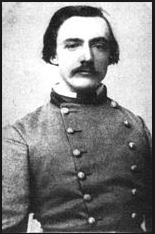
Here is Stovepipe’s photograph, probably in his Kentucky calvary uniform.

“Stovepipe” acquired his nickname in July of (probably) 1862 in this fashion:

“With a mere thirty-five men at his command, he crossed the Ohio [River] – he believed it to be the first Rebel “invasion” of the North – and attacked the town of Newburgh, Indiana, on July 18. There were two hundred or more Federals in the town, though mostly convalescent soldiers in hospitals. To bluff them into surrendering, Johnson mounted two stovepipes on an old wagon and paraded it around to look like artillery. The ruse worked, the town gave up, and he became ever after Stovepipe Johnson.”

Stovepipe was born in Henderson County, Kentucky in 1834, but moved to Burnet, Texas when he was twenty. That’s pronounced BURN’-it, with emphasis on the first syllable, for you non-Texans. He went back to Kentucky when the war broke out, made a name for himself as a scout for Nathan Bedford Forrest and as a recruiter, and eventually organized and equipped the 10th Kentucky Calvary. He was accidentally shot in the face by one of his own men in August 1864, lost his eyesight, and was captured and imprisoned at Fort Warren until the end of the war. He returned to Texas, where he founded the town of Marble Falls (nicknamed “the blind man’s town”), worked to harness the water power of the Colorado River, served as a contractor for the Overland Mail, and founded the Texas Mining Improvement Company. Oh, yeah, he also wrote an autobiography that is considered a “must read” regarding certain aspects of the Civil War.

He died in Burnet in 1922, and was reportedly a happy, cheerful man, blind or not. It sure didn’t slow him down much, did it? I’m just sorry he wasn’t fighting against slavery. He is buried in the Texas State Cemetery in Austin. There is a ton of information about him on the internet. Googling “Adam Rankin Stovepipe Johnson” produces a wealth of hits.[4]

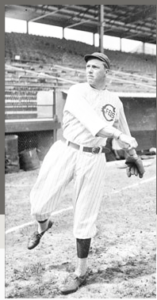
An article posted by the Texas State History Association says that Stovepipe had six children.[5] Keep Googling, and you will find that one of them was named Adam Rankin “Tex” Johnson (1888 – 1972). He was a pitcher for the Boston Red Sox and the St. Louis Cardinals during 1914-1918. His ERA in the majors was a very respectable 2.96. Here is a picture of Tex. Look at that tiny glove!

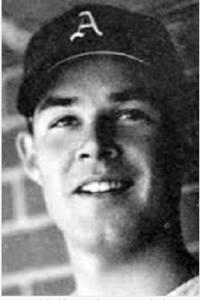
There’s more. Tex had a son named Rankin Johnson Jr. who was a major league pitcher for the Philadelphia Athletics in 1941. He’s a nice-looking fellow, and his tombstone is inscribed “TAKE ME OUT TO THE BALLGAME,” a sentiment I share.[6] Here’s his picture, which makes me smile:

The next time the announcers for the Houston Astros have a trivia question about father-son major league players, I’ll be ready with “Tex” Johnson and Rankin Johnson. I imagine they will be stumped.

The serendipity part

The serendipity was having my Rankin friend drop Brigadier General Adam Rankin “Stovepipe” Johnson’s name in my lap. It doesn’t take too much imagination to deduce that his mother was née Rankin. Yes, indeed, says the Texas State Historical Association summary about Stovepipe. Her name was Julia Rankin, and she was the daughter of … Doctor Adam Rankin of Henderson Co., KY, who was originally from Pennsylvania. There cannot have been too many Pennsylvania Dr. Adam Rankins at that time.

Dr. Adam (son of William and Mary Huston Rankin and brother of Archibald) was evidently “absent” from Pennsylvania in 1792 because he was busy that year marrying Elizabeth Speed of Danville, Kentucky. She was the first of his three wives, by whom Dr. Adam fathered thirteen children — including a daughter Mary Huston Rankin(his eldest child, named for his mother) and an Archibald Rankin (named for his brother and maternal grandfather, Archibald Huston).

There is a biographical article about Dr. Adam’s family from an 1887 history of Henderson County, Kentucky. It has a nice, long exposition of his descendants, and you can see it here..

A proved descendant of Dr. Adam Rankin has Y-DNA tested and joined the Rankin DNA Project. He matches another descendant of Adam and Mary Steele Alexander Rankin. It is not a close match, so the Rankin DNA Project needs another descendant to firm up the line’s Y-DNA profile.

See you on down the road. There are more Pennsylvania Rankins on the horizon than you can shake a stick at.

Robin

*   *   *   *   *   *   *

[1] See the “Follow the Land” article about Adam and Mary’s son William here.

[2] Will of William Rankin of Antrim Township, Franklin Co., PA, dated 20 Oct 1792, proved 28 Nov 1792. “Advanced in age.” Franklin Co., PA Will book B: 256.

[3] Westmoreland Deed Book 7: 392. The deed recites that Archibald Rankin was of Antrim Township, Franklin Co., the 274-acre tract in Westmoreland was originally granted to William Rankin of Antrim on 27 July 1773, and William devised it to his son Dr. Adam Rankin by will dated 20 October 1792. The deed further recites that Dr. Adam Rankin granted his brother Archibald a power of attorney dated 29 Jun 1792. The POA is also recorded at DB 7: 392.

[4] There is a short article posted by the Texas State Historical Association which includes a citation to Stovepipe’s autobiography here..

[5] Id.

[6] Here is a link to Rankin Johnson’s tombstone.


Adam Rankin d. 1747, Lancaster PA, & Mary Steele Rankin’s son William: “follow the land”

Every genealogist has used the “follow the land” (“FTL”) approach to family history research, even if she didn’t call it by that name. An identifiable tract of land can prove family connections via deed, probate, tax, and other records.[1] It can make one grateful to be descended from a bunch of landowning farmers.[2]

In this article, FTL proves the identity of a colonial Rankin’s wife and allows tracking a son’s family with confidence. This Lancaster County, Pennsylvania family claims the “Mt. Horeb legend” for its Irish and Scots ancestors.[3] Descendants of two different Lancaster Rankin immigrants claim the Mt. Horeb legend. The legend says the two were brothers who came to Pennsylvania in the 1720s, although Y-DNA indicates that is probably not correct. Both men died in Lancaster County, Pennsylvania in the 1740s:

    • John Rankin died in 1749. His will named his wife Margaret, sons Richard and Thomas, six daughters, and two sons-in-law; he had eight daughters altogether.[4] Richard and Thomas went to Augusta Co., VA. Thomas’s family continued to east Tennessee.
    • Adam Rankin died in 1747. This article is about the family of his son William.[5]

Adam’s earliest appearance in the colonies was about 1722, when an Adam Rankin signed a petition to Lord Baltimore from landowners in the so-called “New Munster” tract of Cecil County, Maryland. The petition said the signatories believed that they resided in Maryland rather than Pennsylvania.[6] One particular New Munster tract conclusively proves the identity of Adam’s wife. Here is the evidentiary trail …

    • The 1717 will of James Alexander of New Munster devised a 316-acre tract.[7] The will says he had bargained for the land, but hadn’t paid for it or obtained a deed. He instructed his executors to sell as much of his personal property as necessary to pay for the tract. James also instructed that three “honest men … of the neighborhood” divide the land into three equal parts for his family. James named as executors his wife Mary Alexander and his father-in-law John Steele, establishing that his wife was née Mary Steele.
    • Next, a Cecil County deed dated August 1718 completed the purchase of the tract as James had instructed. Thomas Stevenson conveyed 316 acres to Mary Alexander, “widow and relict of James Alexander of New Munster,” and her sons Joseph, John and Francis Alexander. Echoing James Alexander’s will, the deed recites that James had bargained with the grantor for the land but didn’t pay for it before he died, had left money to pay, and instructed that it should be divided into three equal parts.[8]
    • Finally, the tract was divided into three parts by a survey dated September 29, 1724. The survey identifies the tract as 316 acres in New Munster and states that James Alexander’s widow Mary married Adam Rankin.[9]

Thank you, 316-acre tract … the will, deed and survey leave no reasonable doubt that Mary Steele, daughter of John Steele of New Castle County, Delaware, married James Alexander and then Adam Rankin. Also, Mary’s marriage to Adam must have taken place between August 1718 (the conveyance from Thomas Stevenson to Mary Alexander) and September 1724 (the survey).

Adam’s 1747 will provided as follows:[10]

To son James Rankin, £ 5 “pencelvaney currancy,” plus the “place he is now in possession of being fully given over to him.” Daughter Esther Rankin Dunwoody, £ 5. Wife (name not stated), two-thirds “of all my worldly substance.” To sons William and Jeremiah, the residue of my estate, including the plantation, to be equally divided between them.

Adam didn’t identify where his land was located, the names of adjacent landowners, or any other identifying features that would help track it. Fortunately, Adam had obtained a warrant dated November 11, 1742 to survey 100 acres “at Conegocheague.”[11] Conogocheague Creek (various spellings) is near Greencastle, Pennsylvania, less than 5 miles north of the current PA/MD line, in Franklin County.

A Franklin County deed provides confirmation. An 1818 deed conveying land in Montgomery Township, Franklin County, recites that 107 acres of the land sold was part of 188 acres surveyed per a “warrant to Adam Rankin dated 11 November 1742.” The deed establishes that the 107-acre tract descended from Adam to his son James, and then to his son James Jr. by the terms of James Sr.’s 1788 will.[12]

 Adam’s sons James and William fairly leap out of the records of Montgomery and Antrim Townships in Franklin County, a successor county to Lancaster.[13] Both men were listed on the Antrim tax lists along with some of their sons in 1785, 1786 and 1787. Beginning in 1789, William was taxed in Antrim Township; James (Senior, father of the grantor in the 1818 deed) was taxed in Montgomery Township. So far as I have found, James’ and William’s brother Jeremiah never appeared in any county records other than his father’s will.[14]

William and James were more helpful than Jeremiah. Not only did they appear where Adam’s 1742 grant led us to expect, they both left wills. The will of James Rankin Sr. of Montgomery Township, Franklin County, was dated 25 March 1788 and proved 20 October 1795. It names his wife Jean; sons William, Jeremiah, James (Jr.) and David; daughter Ruth Rankin Tool; son-in-law Samuel Smith; and granddaughter Mary Smith. James named his son Jeremiah Rankin and friend David Huston/Houston as executors.[15]

We will leave James Sr.’s family for another day. We’re now on the track of Adam and Mary Steele Alexander Rankin’s son William.[16] William’s wife was Mary Huston, daughter of Archibald and Agnes Huston.[17] William’s will, dated 20 Oct 1792 and proved 28 Nov 1792, suggests he amassed considerable land.[18] William described himself as “of Antrim Township” in Franklin County and “advanced in age” in 1792. Here are his devises and bequests:

    • Wife Mary received one-third of profits from “the mansion place.”
    • Son Adam Rankin inherited 200 acres on the waters of the Kiskimetatas River in Westmoreland County and an enslaved person.
    • Son Archibald Rankin received 200 acres off “the mansion place.”
    • Sons James and William inherited 990 acres in Penns Valley, Mifflin County.
    • Daughter Betsy, £ 400 and an enslaved person. She was less than 21.
    • Son David, “old mansion place,” 300 acres.
    • Sons John and Jeremiah, 408 acres on Spring Creek in Penns Valley in Mifflin County, plus £ 400 from son David starting when they reach 21.
    • Sons Archibald Rankin, James Rankin, and William Rankin, executors.

“Follow the land” is straightforward for some of William and Mary’s children, thanks to that will. I don’t know who their daughter Betsy married, if she married at all. Here is a little bit about their sons.

Adam Rankin (b. 1760-64, d. 1810-20) was a doctor. He moved to Henderson County, Kentucky, where he married three times and produced a large family. One of his grandsons was Confederate Brigadier General Adam “Stovepipe” Rankin Johnson. Some of Dr. Adam’s descendants still live in Kentucky.

Archibald Rankin (1764 – 1845) inherited part of the “old mansion place” in Antrim Township. He apparently stayed in Franklin County until he died. His first appearance in the records was on the 1785 Antrim tax list as a “freeman.”[19] He was a head of household in the federal census of Franklin County from 1790 through 1840 (I could not find him in 1830, although he was still alive).[20] I have not tried to trace his line, although he had a number of children. He belonged to the Presbyterian Church of the Upper West Conococheague. Church records show that he married Agnes Long on 9 Mar 1790 and that a daughter Fanny died in 1827. Church records also say Archibald died 24 Jun 1845 at age 81, indicating he was born about 1764.

David Rankin (b. 1776 – 1777, d. 1853) inherited part of the “old mansion place” along with his brother Archibald. His wife was Frances (“Fanny”) Campbell, daughter of Dugald (Dugal/Dougal/Dongal) Campbell. David left Franklin County between 1820 and 1830 and wound up in Des Moines County, Iowa, where he died.[21]

The remaining four sons are FTL exemplars. That is because William’s 1792 will devised land in Penn’s Valley, Mifflin County, some of it on Spring Creek, to his sons James, William, John and Jeremiah. The will proves that John and Jeremiah should be located close to each other, since they shared an inherited tract. James and William should be located near each other for the same reason. Centre County was created in 1803 from Mifflin County, and the two Mifflin County tracts devised by William in 1792 were subsequently located in Centre County. Spring Creek runs through the middle of Bellefonte, the Centre County seat.

Jackpot! There they are, all four of them in Centre County, paired off geographically just as one would expect. One page of the 1810 census for Potter Township in Centre County has James Rankin listed two households down from William Rankin. Another page has listings for Jeremiah Rankin and John Rankin. All four men are in the age 26 < 45 category, born during 1765 – 1784. We know that Jeremiah and John were underage in 1792 when their father wrote his will, so they would have been born after 1771. We know that Archibald, an elder brother, was born in 1764. Those birth ranges fit like a glove, with further confirmation in later census records.

There is no reasonable doubt that these four men were sons of William and Mary Huston Rankin and grandsons of Adam and Mary Steele Alexander Rankin. A conventional descendant chart for the Centre County Rankins is under construction. It grows every time I search the census records, and the number of physicians on this family’s tree is incredible. If you are descended from a Dr. Rankin who lived in Pennsylvania in the mid 1800’s, you might want to look at this line. If you are interested in joining the D.A.R., this is an admission ticket, because the D.A.R. has admitted at least two women based on the service of the William Rankin who died in Franklin County in 1792. I will post the descendant chart eventually, God willing and the bayou don’t rise. Meanwhile, here is a skeletal chart for this line:

1 Adam Rankin d. 1747, Lancaster Co., PA. Wife Mary Steele Alexander, widow of James.

2 Jeremiah Rankin, whose only known appearance in primary records was Adam’s 1747 will. Died 1760 in Cumberland Co., PA in a mill accident. Wife Rhoda Craig. Four sons went to Fayette/Woodford Counties, Kentucky.

2 James Rankin Sr., d. 1795, Franklin Co., PA.

2 William Rankin (Sr.), d. 1792, Franklin Co., PA, wife Mary Huston. See will devising land in Penns Valley, Mifflin County, including a tract on Spring Creek.

3 William Rankin (Jr.), b. 1770 Cumberland Co, PA, d. 1847, Centre Co., PA. Two wives, Abigail McGinley and Susanna (reportedly Huston). The tract of land he inherited is proof that he was a son of William and Mary Huston Rankin. Children are also established, see Centre County Will Book B: 254, naming eight children, including Adam, Archibald, James, John, and …

4 Dr. William Rankin (III) (1795-1872) moved to Shippensburg in Cumberland Co.[22] Had 11 children, at least one of whom was a physician, and a Presbyterian minister:

5 Rev. William Alexander Rankin.[23]

If you want to get into a good knock-down, drag-out fight, go search for family trees that include “William Jackson Rankin” and “William Johnson Rankin.” You will find S.A.R. applications in support. You will find a totally different line than that outlined above, although it will also go back to Adam and Mary Steele Rankin. I hereby proffer my version, above, which should incite the argument.

*   *   *   *   *   *   *

[1] For example, a series of deeds concerning a tract in Tishomingo Co, MS conclusively proved almost all of the children of Lyddal Bacon Estes and “Nancy” Ann Allen Winn. See an article about them at this link..

[2] The ones whose enslaved people did the actual work frequently called themselves “planters.”

[3] The Mt. Horeb legend is transcribed in the article at this link.

[4] Lancaster Co., PA Will Book J: 211, will of John Rankin dated 1 Jan 1749, proved 25 Feb 1749/1750. Wife Margaret, sons Thomas and Richard, daughters Elizabeth, Ann, Margaret, Catrin, Rebecca, and Agness Rankin, and sons-in-law William White and John Waugh. See image of original at FamilySearch.org, Pennsylvania Probate Records, 1683 – 1994, Lancaster, Wills 1747-1830 Vol. I-K, image #352. Family oral history identifies John’s wife as Jane McElwee. His will names his wife Margaret. That might mean that either (1) the oral history was incorrect or (2) Jane McElwee died and John remarried to Margaret MNU. Either one is possible and plausible. Instead, many family trees identify John’s wife as Margaret Jane McElwee. The odds that is correct are de minimis, considering how rare middle names were at that time, even for men.

[5] Lancaster Co., PA Will Book J: 208, will of Adam Rankin dated 4 May 1747, proved 21 Sep 1747. He named his son James (to receive “the place he is now in possession of”), wife (name not given), and sons William and Jeremiah (“the plantation to be equally divided”). See image of original will at FamilySearch.org, Pennsylvania Probate Records, 1683 – 1994, Lancaster, Wills 1747-1830 Vol. I-K, image #351.

[6] Henry C. Peden, “Inhabitants of Cecil County, Maryland 1649-1774 (Westminster, MD: Family Line Publications, 1993) 33. Actual hostilities (called “Cresap’s War”) broke out between Maryland and Pennsylvania during the 1730s over competing land claims by the two states. Check out the great map at this link..

[7] Will of James Alexander of New Munster, Cecil Co., MD dated 12 Jul 1717, probate date unknown (but before August 1718, when a deed recited some provisions of the will). The will is recorded in New Castle Co., DE, where John Steele, an executor, resided. There is evidently no copy in the Cecil Co. records. I don’t know whether the will is preserved in the Maryland Archives. Floyd Owsley, an administrator of the Alexander DNA Project, provided a transcription of the will to me.

[8] Cecil Co., MD Deed Book 3: 212.

[9] Cecil County Circuit Court Certificates, No. 514, survey of 316 acres for the heirs of James Alexander dated 28 Sep 1724. Floyd Owsley provided a copy of the original and a transcription.

[10] Lancaster Co. Will Book J: 208, will of Adam Rankin dated and proved in 1747. Note 5.

[11] Floyd Owsley, a descendant of the New Munster tract Alexanders, emailed an image of the original document to me. It is labeled “No. 111” and appears to be a warrant to survey 100 acres “situate at Conegocheage between the lands of Samuel Owen, James Swaffer, Samuel Brown, and the Blue Mountains.”

[12] Franklin Co., PA Deed Book 12: 28.

[13] Some speculate that James was the son of Adam’s wife prior to Mary Steele Alexander. Family oral history says that Adam was married first to an Elizabeth May, although I am not aware of any evidence in either colonial or Irish records. Adam and Mary Steele were married after 1718 but before 1724; Adam was in the colonies by no later than 1722.  There is no indication in Adam’s 1747 will that any of his sons were minors, so the three were most likely all born by 1726. One can infer from the will that James was already living on the tract he inherited and that William and Jeremiah were still living on the home plantation. Perhaps the fact that James appears to be the oldest is the rationale for thinking he was the product of an earlier marriage.

[14] Secondary evidence (i.e., evidence other than official records) establishes that Jeremiah Rankin, son of Adam and Mary Steele Rankin, died in 1760 in a mill accident. See an article about one of Jeremiah’s sons, Rev. Adam Rankin of Lexington, Co., here.

[15] Franklin Co., PA Will Book A: 345 (estate #354).

[16] Online trees sometimes give William’s name as William Steele Rankin. That would be logical, since his mother’s maiden name was Steele. However, men born in the early 1700s very rarely had middle names, e.g., George Washington, Benjamin Franklin, Thomas Jefferson. Not a middle name among them. Further, there is not a shred of evidence in actual records that William ever used even a middle initial, much less a middle name. If anyone can produce any convincing evidence of any middle name for William, son of Adam, I will eat both my hat and my laptop.

[17] Virginia Shannon Fendrick, American Revolutionary Soldiers of Franklin County, Pennsylvania (Chambersburg, PA: Historical Works Committee of the Franklin County Chapter of the Daughters of the American Revolution, 1944), citing Pennsylvania Archives 5th Series, Vol. 6, at 576 and 583. “WILLIAM RANKIN of Antrim Twp., appears as a private under Capt. James Poe, 1782, and [on] an undated roll. He married Mary Huston, daughter of Archibald, as shown by the will of Agnes Huston, widow of Archibald.” See will of Agness Huston, Franklin Co., PA Will Book A: 110, will dated 15 Nov 1776, proved 14 Mar 1787, naming William Rankin, husband of daughter Mary, an executor.

[18] Franklin Co. Will Book A-B: 256, will of William Rankin of Antrim Township.

[19] That means Archibald was age 21 or over, not married, and not a landowner.

[20] 1790 census, Franklin Co., Archybald Rankin, 1-0-2-1-0; 1800 census, Burough of Greencastle (Antrim Twp.), Archd Rankin, 20110-20010; 1810 census, Montgomery Twp., Franklin Co., Archibald Rankin, 01101-12110; 1820 census, Montgomery Twp., Franklin Co., Archibald Rankin, 000101-02300; 1840 census, Peters Township, Franklin Co., Archibald Rankin, age 70 < 80, was the sole member of the household.

[21] See the article about David, son of William and Mary Huston Rankin, and his cousin David, son of James and Jean Rankin, here.

[22] John Blair Linn, History of Centre and Clinton Counties (Philadelphia: Louis H. Everts, 1883), at 222. Identifies some of the children of William Jr., including a Dr. William Rankin who moved to Shippensburg in Cumberland Co. and died before the book was published.

[23] Even I will trust Findagrave when it cites to the Minutes of the General Assembly of the Presbyterian Church in America. See memorial on find-a-grave.

Revised: the most famous Rankin legend of all

A friend who reads this blog suggested bluntly that I belly up to the bar and say in no uncertain terms whether a certain famous Rankin legend is accurate. Here is what I think. I hope it will encourage a commenter to share some evidence.

* * * * * * * * *

Specifically, this is about a widely claimed Rankin family history oral tradition. The legend calls to mind an old expression, possibly of Native American origin: “this story might not have happened exactly the way I have told it … but it is nevertheless true.”[1] Let’s call this Rankin story the “Mt. Horeb legend” because it is inscribed on a bronze tablet in the Mt. Horeb Presbyterian Church cemetery in Jefferson County, Tennessee. I have transcribed it below. For the most part, I think it is charming but inaccurate myth.

The storyteller’s caveat is tailor-made for the Mt. Horeb legend. Specific facts in the legend about some family relationships and martyred Rankins  are suspect, although the essence of the story is true for many Scots-Irish. Some Rankins were Covenanters, i.e., Presbyterian Scots who were brutally persecuted during the Killing Times.[2] Many Scots migrated to Ulster, some during the worst of the Killing Times in the 1680s.[3] Some Rankins survived the Siege of Londonderry in 1689.[4] Many Presbyterian Rankins migrated from Ireland to the Delaware River ports during the Great Migration from 1717 until about 1770. A good many Scots-Irish Rankins fought in the Revolutionary War.

The Mt. Horeb legend features every bit of that. It is a staple of many Rankin family trees. It has problems. Y-DNA results create a question mark. Traditional paper research adds others. Lack of evidence abounds. The legend is not part of the oral family history of two early Rankins descended from the Mt. Horeb immigrants. That suggests the legend was added to their family histories after their lifetimes, diminishing the credibility of what is characterized as an oral family tradition.

Having dealt with a bunch of genealogical horse hockey, I have become cynical. I occasionally suspect that some Rankin became familiar with Scots-Irish history, did some research overseas and in Pennsylvania, conflated several people having the same names, and wove a darn good story from fragments. I will probably be burned in effigy for saying that out loud.

The Mt. Horeb legend is the only family tradition I know that is actually cast in metal, so let’s look at the entire story.  To be clear, I am not presenting this as a correct factual statement. I am presenting it as a statement of what some believe their Rankin history to be. Following the transcription, I have discussed some of its claims.

Here is the tablet’s inscription, verbatim:

THIS TABLET IS TO COMMEMORATE
THE MEMORY OF

RICHARD RANKIN 1756 – 1827         SAMUEL RANKIN 1758 – 1828

THOMAS RANKIN 1762 – 1827        JOHN BRADSHAW 1743 – 1818

FOUR PIONEER SETTLERS OF DUMPLIN VALLEY

GENEALOGY OF THE RANKIN FAMILY

GENERATION 1

ALEXANDER RANKIN, BORN IN SCOTLAND, HAD THREE SONS, TWO WERE MARTYRS TO THEIR RELIGION. OF THESE ONE WAS KILLED ON THE HIGHWAY, THE OTHER SUFFOCATED IN A SMOKEHOUSE[5] WHERE HE HAD TAKEN REFUGE TO ESCAPE HIS PURSUERS. THE THIRD BROTHER, WILLIAM, TOGETHER WITH HIS FATHER AND FAMILY ESCAPED TO DERRY COUNTY, IRELAND IN 1688. WILLIAM AND HIS FATHER, ALEXANDER RANKIN, WERE PARTICIPANTS IN THE SIEGE OF LONDONDERRY, WHICH TOOK PLACE IN 1689.
ALEXANDER RANKINS NAME IS SIGNED TO THE PETITION OF THANKS TO ALMIGHTY GOD, AND WILLIAM, KING OF ORANGE, FOR HIS TIMELY ASSISTANCE IN RAISING THE SIEGE IN AUGUST, 1689.

GENERATION 2

WILLIAM RANKIN HAD THREE SONS, ADAM, BORN IN SCOTLAND, 1699. JOHN AND HUGH BORN IN IRELAND.
ADAM AND HUGH CAME TO AMERICA IN 1721, LANDING IN PHILADELPHIA. PA., AND SETTLED IN CHESTER COUNTY, HUGH WAS KILLED IN A MILL ACCIDENT. ADAM MARRIED MARY STEELE.

GENERATION 3

JOHN RANKIN MARRIED JANE McELWEE, IN IRELAND, CAME TO AMERICA IN 1727. HE HAD TWO SONS, THOMAS AND RICHARD, AND EIGHT DAUGHTERS. RICHARD MARRIED A MISS DOUGLASS AND SETTLED IN AUGUSTA COUNTY, VA.

GENERATION 4

THOMAS RANKIN, 1724 – 1828, MARRIED ISABEL CLENDENON OF PA. AND SETTLED IN THAT STATE. THEIR CHILDREN WERE:

JOHN 1754 – 1825 MARRIED MARTHA WAUGH

RICHARD 1756 – 1827 MARRIED JENNETT STEELE

SAMUEL 1758 – 1828 MARRIED – PETTY

WILLIAM 1760 – 1834 MARRIED SARAH MOORE

THOMAS 1762 – 1821 MARRIED JENNETT BRADSHAW

JAMES 1770 – 1839 MARRIED MARGARET MASSEY

JANE MARRIED WILLIAM GILLESPIE

MARGARET MARRIED SAMUEL HARRIS

ANN MARRIED LEMUEL LACY

ISABEL MARRIED ROBT. McQUISTON

NANCY MARRIED SAMUEL WHITE

MARY MARRIED JAMES BRADSHAW

THOMAS RANKIN OF GENERATION 4, WAS A CAPTAIN IN THE REVOLUTIONARY WAR. HIS FOUR ELDEST SONS WERE PRIVATES IN SAID WAR.
 THIS TABLET WAS ERECTED IN 1930 BY
CHRISTOPHER HOUSTON RANKIN 
COURTLAND THALES RANKIN, ATTY 
REV. JOHN GRANT NEWMAN, D.D.
 MRS. ALMYRA – RANKIN – McMURRAY 
MRS. ROZEE – RANKIN TAYLOR 
FRANK WALTER RANKIN 
HARRY JAY RANKIN
 SAM HULL RANKIN

End of transcription.

I hope someone will share evidence proving that the legend is accurate in every respect. While we are waiting, here is a summary of statements in the legend that (in my opinion) are either (1) true or probably true, (2) incorrect, or (3) may be correct but lack supporting evidence.

First, here are the facts that are either supported by evidence or are so consistent with historical events that they are almost certainly true:

    • There was an Alexander Rankin whose name was on a petition of thanks to God and William of Orange for lifting the Siege of Londonderry.
    • Many Scottish Presbyterians were victims in the Killing Times in the 1680s.
    • Many Rankins migrated from Scotland to the Province of Ulster. Some may have fled to escape the Killing Times.
    • Two Rankins named John and Adam lived in Lancaster County, Pennsylvania in the second quarter of the eighteenth century.
    • Many Scots-Irish, including Rankins, entered the colonies in a Delaware River port such as Philadelphia.
    • Adam Rankin of Lancaster County married Mary Steele Alexander, widow of James Alexander.
    • John Rankin had two sons, Thomas and Richard, and eight daughters.
    • Richard, son of John, migrated to Augusta County.
    • Thomas, son of John, did “settle” in Pennsylvania for a time. His wife was Isabel Clendenon/Clendenin (various spellings).

Second, here are some statements that are either obvious error or are cast in serious doubt by county and other records:

    • If Adam Rankin was born in Scotland in 1699, then his family was not in Ireland for the 1689 Siege of Londonderry.
    • Thomas Rankin, son of John, was not a Revolutionary War Captain.
    • Three of Thomas Rankin’s four eldest sons (Richard, Samuel, and William) were revolutionary soldiers. John, the eldest son, was not.
    • John Rankin (died in 1749 in Lancaster County) and Adam Rankin (died there in 1747) were not brothers. Y-DNA testing has conclusively disproved that assertion.
    • It is unclear what it means to say that Thomas and Isobel Clendenin Rankin “settled” in Pennsylvania. It seems to imply they stayed there. Their son William’s Revolutionary War Pension Application establishes that the family moved to Augusta County, Virginia in 1780.

Third, here are some of the evidentiary issues. There is no evidence that …

      • … any Rankins were executed during the Killing Times or are on lists of known martyrs. However, a John Rankin from Biggar Parish, Lanarkshire, is known to have drowned off Orkney in a ship loaded with Covenanter prisoners.
      • … Alexander Rankin, grateful survivor of the Siege of Londonderry, had a son William and grandsons John, Adam, and Hugh.
      • … a William Rankin was present at the Siege.
      • … a Hugh Rankin migrated to the colonies and died in a mill accident. There is evidence that Jeremiah, a son of Adam and Mary Steele Rankin, died in a mill accident.
      • … William Rankin’s wife was Dorothy Black and their sons were John, Adam, and Hugh.
      • … the Adam Rankin who died in Lancaster in 1747 had a wife prior to Mary Steele Alexander.
      • … John Rankin, whose widow was named Margaret, was married to a Jane McElwee.

I would not be surprised to learn, for example, that some John Rankin married a woman named Jane McElwee in Ireland. What we need is evidence that the John Rankin who married Jane McElwee (for example) was the same man as the John Rankin who died in 1749 in Lancaster County, Pennsylvania, leaving a widow named Margaret, eight daughters, and two sons.

Surely, there is someone out there who has proved some of the facts in the Mt. Horeb legend. Halllloooooo?????? If you will marshal the evidence, I invite you to write a guest column for this blog. Or provide the evidence to me and I will write the article.

See you on down the road.

Robin

[1] That saying is a charming way to distinguish narrative from bare facts.

[2] “Covenanters” were originally signers of the “National Covenant” at Greyfriars Church in 1638, although the term expanded to include all Presbyterians  who objected to the requirement that they conform to the liturgical practices and governance of the Church of England. Sources disagree about the precise time period called the  “Killing Times,” when Covenanters were brutally persecuted. I am doing research for an article about Covenanters, a difficult period in Scottish history.

[3] Migration from Scotland to Ireland in substantial numbers began around 1610, when James I encouraged settlement of appropriated land in the province of Ulster. A second large wave of migration occurred during the 1680s, when persecution of Covenanters was intense. See an article about Scots-Irish migration here.

[4] William R. Young’s book The Fighters of Derry (originally published 1932) allegedly lists Alexander Rankin, his sons John and Alexander, and his granddaughter Martha (daughter of the younger Alexander). I have never seen a copy of the book, which isn’t available locally.

[5] A smokehouse is a building where meat or fish is cured with smoke. In Britain it is called a “smokery.”

Pennsylvania Rankins: William and Abigail of Washington County

First, a warning: roughly a gazillion Rankins lived in southern Pennsylvania beginning in  the mid-eighteenth century. At least it feels that way. Rankins litter the deed books from Chester County in the east to Washington in the west. You may think you are researching only one Rankin line in only one county. Ha! Before you know it, you have worked your way through every county on the Maryland border.

The bottom line is that undertaking Rankin family research in southern Pennsylvania is a slippery slope … a course of action that leads inevitably from one action or result to another with unintended consequences. This may result in a  scorched-earth march through deed records in multiple counties. Washington County alone had, as nearly as I can tell, seven distinct Rankin families.

Let’s start with one of them: William and Abigail Rankin. He was a son of David Rankin Sr. and Jennett McCormick Rankin of Frederick County, Virginia.[1] For the record, David’s wife Jennett did not have the middle name “Mildred.” And William did not have the middle name McCormick.

Two deeds in Frederick prove that William’s wife was named Abigail and that he owned a tract of land in Frederick called “Turkey Spring.”[2] William’s will proves that he and Abigail moved to Washington County from Frederick because his will in Washington names his wife Abigail and devises Turkey Spring to his son William (Jr.). Boyd Crumrine’s 1882 History of Washington County, Pennsylvania says that William and most of his family came to the area in 1774.[3]

William died in Washington County in 1793. He named ten children in his will – eight sons and two daughters – as well as some of his grandchildren.[4] Charles A. Hanna’s book on Ohio Valley genealogies identifies a ninth son James, who was killed by Native Americans while returning to Pennsylvania from a trip to Kentucky.[5]William identified himself in his will as a resident of Smith Township on the middle fork of Raccoon Creek. That location distinguishes this family from other Rankins in the county for the better part of a century. The Raccoon Creek area was incorporated in Mt. Pleasant Township, and many of William’s descendants are buried in Mt. Prospect Cemetery in that township.

Four of William’s sons – John, Thomas, Jesse and Zachariah – served in the Washington County militia.[6]Thomas was a D.A.R.-recognized Revolutionary War veteran.[7] The brothers served in the 4th Company, 4thBattalion, in Washington County. John Rankin was a Lieutenant.[8] An official list of Revolutionary War soldiers buried in Ohio names Thomas Rankin, who is buried in Harrison County, and identifies his three brothers and their parents.[9] A Pennsylvania Historical & Museum Commission website says the Rankins’ company was from the area of Raccoon and Millers Run, so we know that we are looking at the right family.

Here is some information about William and Abigail’s sons. I have omitted their daughters Mary Rankin (married Thomas Cherry) and Abigail Rankin (married Charles Campbell), whom I did not research.

David Rankin, born by 1755, died unknown. David, probably the eldest son, inherited the tract where he lived from his father. If you followed the link to Boyd Crumrine’s 1882 History in footnote 3 of this article, you saw Crumrine’s assertion that David remained in Virginia. That wasn’t the case. Charles Hanna made the same mistake. Two deeds involving his inherited tract make it clear that David and his wife Grace (maiden name unknown) lived on Raccoon Creek in the middle of their Rankin family.[10]

David arrived in Washington County no later than 1781, when he appeared on a Smith Township tax list with his father William and brothers John, Matthew and Zachariah.[11] David sold parts of his inherited land in 1799 and 1805.[12] He was listed in Washington County in the 1800 and 1810 censuses. Taken together, the censuses suggest he had at least three daughters and a son born between 1784 and 1810.[13] I haven’t found where David went after 1810, and don’t know the names of his children.

There is at least one online tree that has confused David, son of William and Abigail, with William’s brother David. The latter moved to Cynthiana, Harrison County, Kentucky. This creative tree has David born when both of his parents were less than ten years old.[14] Never a dull moment with online trees!

John Rankin, born by 1760, died in 1788 in Washington County. John left a will naming his wife Rebecca and minor children James and Mary.[15] Their grandfather William Rankin left the two children 253 acres.[16] In 1808, James and Polly sold that tract, located “on the waters of Raccoon Cr.” The deed recited that John’s widow Rebecca Rankin had married Jonathan Jacques, which helped track the family.[17] James accepted notes for part of the purchase price, and the record of the 1808 mortgage identifies him as a resident of Harrison County, Kentucky.[18]There is a listing in the 1810 Harrison County census for a John Jaquess and an Isaac Jaquess. The latter is listed three households down from a James Rankin, who is a good bet to be the son of John Rankin and Rebecca Rankin Jacques.[19] Other members of the Frederick-Washington Rankin family also moved from Washington to Harrison County, but I will save them for another day.

William Rankin (Jr.). William Sr.’s will devised to William Jr. the tract where William (Sr.) formerly lived called “Turkey Spring.”[20] I haven’t attempted to track William Jr. in Virginia. Some online trees identify him as a Revolutionary War soldier (1748-1830) buried in the Mahnes Cemetery in Morgan County, West Virginia. That William may belong to another Rankin family from the Northern Neck of Virginia. It may be that the only way to resolve that question is Y-DNA testing.

Matthew Rankin, born by 1755, died in 1822, Washington County. Matthew’s wife was Charity, maiden name unknown. The couple apparently had no surviving children because Matthew willed all his property to his wife, his brother Jesse, and some nieces and nephews.[21] Matthew was clearly the family caretaker, ensuring enforcement of a family agreement to distribute the family land equally, and acting as executor of his brother Zachariah’s will.[22]

Zachariah Rankin, born by 1760, died 1785, Washington County. Zachariah clearly knew he had a fatal illness before he died, because he executed his will on Oct. 17, 1785 and it was proved exactly one week later.[23]Crumrine tells us that Zachariah died of hydrophobia from the bite of a rabid wolf. What an awful death. His probate file might make you smile, though: his brother Matthew’s spelling (or misspelling) throughout is charming. Zachariah’s wardrobe is described in some detail, suggesting a well-outfitted frontiersman. Here is a list:

    • 2 Shirts
    • 1 coat 1 Jacket ____ & wool
    • one coat & one Jacket of thick cloath
    • one Pair of Buckskin Briches
    • one pair of Cordoroy Ditto & Jacket Nee Buckle
    • one Pair of Leggins one Letout Coat
    • one Jacket
    • one Beaver Hat & one Wool hat
    • three Pair of stockings
    • one Silk Handkerchief & one linnen Ditto

Reading between the lines, there are a couple of other interesting details in Zachariah’s estate files. The only people who bought anything at Zachariah’s estate sale were named Rankin, except for Thomas Cherry, Zachariah’s brother-in-law. That suggests that either (1) the estate sale was attended only by family, which is highly improbable, or (2) the Rankins and Cherry outbid everyone on every item. Also, Zachariah’s brother Thomas bought five gallons of whiskey for Zachariah’s funeral. Either attendance at the funeral was considerably larger than attendance at the estate sale, or the Rankin family had an enormous capacity for alcohol.[24]

Thomas Rankin, born 16 Sep. 1760, died 1832, Cadiz Township, Harrison Co., Ohio.  Thomas’s wife was named Ann (nickname Nancy). Her maiden name was Foreman, according to Charles Hanna. Like his brothers, Thomas inherited land on Raccoon Cr. from his father. He is listed in the 1790 Washington County census adjacent William Sr. That census suggests two sons and one daughter born by 1790.[25] Hanna identifies five children named James, William, David, Jane and Nancy.

Thomas sold his land in two deeds in 1798, which may be when he left Washington County.[26] Thomas appeared on the 1810 tax list and 1820 census in Cadiz Township in Harrison County. In the 1820 census, he is listed adjacent a David Rankin, possibly his son. Thomas is buried in the Rankin Methodist Episcopal Cemetery in Cadiz Township.[27]

Jesse Rankin, born 1763, died 21 Sep. 1837, Mt. Pleasant Township, Washington County. Jesse’s probate files conclusively establish the identities of his eight surviving children: sons Matthew, William, Isaac and Jesse, and daughters Margaret (married James Futen or Tuten or Teten), Abigail (married Robert Tenan or Tinan), Jane (never married), and Maria or Mariah (married George Kelso). The probate files are full of information. Some of it suggests that members of this branch of the Rankin family had each other’s backs.[28]

First, there was a quitclaim deed from Jesse’s widow Jane (maiden name unknown) and their four sons to their four daughters, giving each one personal property essential for an early 19th-century female: a bed and bedclothes, saddle and bridle, some flax yarn and flannel, and a cow and calf. Also, a set of silver teaspoons, a luxurious gift in the early 1800s.

Second, the family agreed to give Isaac a share of the estate over and above what he would have been entitled to under the law of intestate descent and distribution. The family did that because Isaac had continued to live with and work for his family as an adult. The family’s agreement recites that “for and in consideration of the labours and services of … Isaac Rankin for and during the time of 6 years 9 months which he … continued with his father and family after he arrived at 21 years of age … $100 per year for the said time … to be paid by the Administrators of Jesse … over and above the legal share of the estate.” Nice.

Samuel Rankin, born about 1767, died October, 1820, Washington County.[29] Samuel died intestate and left little trace in the records. Charles Hanna says his wife was Jane McConahey.[30] Samuel’s brother Matthew named Samuel and Jane’s children in his will:[31] John, David, Samuel, James, Stephen, Matthew, Matilda, Abigail, and Jane. Charles Hanna adds a son William. Matthew’s will in Washington County Will Book 3 is now typewritten, presumably copied from the original handwritten will book. Perhaps either the clerk who first entered the will in the records, or the typist who later transcribed it, omitted William. It’s a solid bet that Hanna was correct, and Samuel had a son William. Further, the 1850 census for Washington County has two William Rankins living in Mt. Pleasant Township, where Matthew’s land had been divided among his brother Jesse and the children of his brother Samuel. One William was likely Samuel’s son, and the other William was Jesse’s son.

And that’s enough for me on the Rankins of Raccoon Creek, Washington County. I have a feeling I will be returning to that county soon enough, because there are a slew of Rankins there just begging for attention.

See you on down the road.

Robin

*  *  *  *  *  *  *  *  *  *

[1] Will of David Rankin dated 5 Nov 1757, proved 2 Aug 1768, naming wife Jennett, sons David, William, and Hugh, and daughter Barbara. Frederick Co., VA Will Book 3: 443.

[2] Amelia C. Gilreath, Frederick County, Virginia Deed Books 5, 6, 7, 8, 1757-1763 (Nokesville, VA: 1990), abstract of Deed Book 5: 343-345, lease and release dated Sept. 3 and 4, 1759, from William Rankin of Frederick to John Smith, a tract on Opeckon Cr. called “Turkey Spring,” part of a 778-acre grant from Lord Fairfax to William and David Rankin (William’s father, David Sr.) on 30 October 1756. William and Abigel (sic) Rankin signed the release. See id., abstract of Deed Book 5: 398-400, lease and release dated Mar. 2 and 3, 1760, from David Rankin Sr. and William Rankin, all of Frederick Co., to David Rankin Jr., 463 acres on a branch of Opeckon Cr., part of a 778-acre grant to David and William dated 30 Oct. 1756 from Lord Fairfax. David Rankin, Jannet (sic) Rankin, William Rankin, and Abigill (sic) Rankin all signed.

[3] Boyd Crumrine, History of Washington County, Pennsylvania (Philadelphia: L. H. Everts & Co., 1882). The book is online  here.

[4] Bob and Mary Closson, Abstracts of Washington County Pennsylvania Willbooks 1-5 (1776-1841) (Apollo, PA: Closson Press, 1995), will of William Rankin of Smith Twp. and the “middle fork of Raccoon Creek,” dated 10 Apr 1793 and proved 21 Oct 1793.

[5] Charles A. Hanna, Ohio Valley Genealogies Relating Chiefly to Families in Harrison, Belmont and Jefferson Counties, Ohio, and Washington, Westmoreland, and Fayette Counties, Pennsylvania (New York: Press of J. J. Little & Co., 1900) 104-105. It is online  here.

[6] Jane Dowd Dailey, DAR, under the direction of the Ohio Adjutant General’s Department, The Official Roster of the Soldiers of the American Revolution Buried in the State of Ohio, Vol. 1, p. 300 (Columbus, OH: The F. J. Heer Printing Co., 1929). Here is a  link.

[7] Here is a link to an image of Thomas’s tombstone. Notice the DAR Rev War marker to the left. Crumrine (see note 3) says Thomas moved to Cadiz, Ohio. The Rankin cemetery where Thomas is buried is located there, and there is a tombstone image here.

[8] Pennsylvania Archives Series, Series 6, Volume II 133, 144.

[9] See note 6, Dailey, Official Roster, Vol. 1 300.

[10] Washington Co., PA Deed Book 1P: 232, deed dated 8 May 1799 from David and Grace Rankin of Smith Township to James Denny, a tract on Raccoon Cr. adjacent James Leach, willed by William Rankin to his son David; Washington Co. Deed Book 1T: 12, deed of 11 Jan 1805 from David Rankin of Smith Township to William Rankin, son of Samuel Rankin, for love and affection and $100, the tract where David now resides adjacent James Leach.

[11] Raymond Martin Bell and Katherine K. Zinsser, Washington County, Pennsylvania Tax Lists for 1781, 1783, 1784, 1793 and Census for 1790 (Bowie, MD: Heritage Books, Inc., 1988).

[12] See note 10.

[13] 1800 federal census, Washington Co., Smith Twp., David Rankin, 10001-01001; 1810 federal census, Washington Co., Mt. Pleasant Twp., David Rankin, 01001-20101. The census suggests that David was born by 1755, as was his wife Grace. If the children in his household were his, he had a daughter b. 1784-1790, son b. 1794-1800, and two daughters b. 1800-1810

[14] See this tree on  Ancestry. If you visit that tree, please be advised that it is replete with errors.

[15] Family History Library DGS Film No. 5,537,968, Washington Co., PA Will Book 1: 81, will of John Rankin of Smith Township dated 16 Feb 1788 and proved 22 Apr 1788 naming wife Rebecca, father William, and children James and Mary.

[16] Closson, Abstracts of Washington County Pennsylvania Willbooks, 1793 will of William Rankin.

[17] Washington Co., PA Deed Book 1U: 130, deed dated 22 Feb 1808 from James Rankin for himself and as attorney for Polly Rankin. The deed recites that James and Polly inherited the tract from their father John Rankin, who left a wife Rebecca, “now married to Jonathan Jacques.”

[18] Id., Washington Co., PA Deed Book 1U: 132, mortgage dated 22 Feb 1808 reciting the sale of land by James and Polly Rankin and stating that James Rankin was “of Harrison Co., KY.”

[19] 1810 federal census, Harrison Co., KY, listings for John Jaquess (32001-03100, 2 slaves), Isaac Jaquess (00100-001), and James Rankins (11000-11001). James is listed in the 10<16 age category, which is too young to be James, son of John and Rebecca. I imagine this is an example of census error, particularly since there is a female in the 26 < 45 age category in the household.

[20] See note 2.

[21] Washington Co., PA Will Book 3: 484, will of Matthew Rankin Sr. of Mt. Pleasant Twp. dated 20 Dec 1821, proved 25 Apr 1822. Matthew named (1) his nephew Matthew Rankin (Jr.), the 4th son of Matthew’s deceased brother Samuel Rankin (60 acres), (2) his brother Jesse (100 acres), (3) his brother Samuel’s other children John, David, Samuel, James, Stephen, Matilda, Abigail, and Jane Rankin (the rest of Matthew’s land), and (4) nephews James Rankin (cash and clothes), son of Matthew’s brother Thomas, and nephew John Cherry, son of Thomas and Mary Rankin Cherry (cash).

[22] Washington Co., PA Deed Book 1B: 374, agreement dated 13 Aug 1785 among William Rankin of Smith Township and his sons Matthew Rankin, Zachariah Rankin, and Jesse Rankin, all of Smith Township. The three brothers gave to William Rankin all rights to lands adjacent to the settlement where William Rankin lived that “come to our hands from the office of Philadelphia.” In return, William promised to make “equal division according to quantity and quality” among William’s sons. William’s will failed to honor that agreement by devising to his sons Samuel and Jesse the share of William’s land to which Zachariah (who predeceased William) was entitled. Zachariah’s only heir, his daughter Abigail, was entitled to that land. Matthew remedied that situation with several deeds in order “to do justice and equity” according to the contract and William’s will, ensuring that Zachariah’s daughter received that land. Washington Co., PA Deed Book 1R: 186, Deed Book 1R: 189, and DB 1R: 295. The last deed contains a conveyance from Jesse and Samuel Rankin to Abby Rankin (Zachariah’s only child and heir), “it being the share of William Rankin’s estate to which Zachariah was entitled,” all in order “to do justice and equity” according to the contract among William and his sons.

[23] Washington Co., PA Will Book 1: 52, will of Zachariah Rankin naming wife Nancy, father William Rankin, and his unborn child (an afterborn daughter named Abigail). Zachariah named his brother Matthew to be his executor.

[24] Family History Library DGS Film 5,558,493, Probate File # R9.

[25] 1790 federal census for Washington Co., PA, Thomas Rankin, 12201 (1 male 16+, 2 males < 16 [ b. 1774-1790], and 2 females, suggesting 2 sons and 1 daughter).

[26] Washington Co., PA Deed Book 1N, 665 and 754, conveyances by Rankin and wife Ann in two deeds, 100 acres and 150 acres.

[27] See note 7.

[28] Family History Library Films 5,558,495 and 5,558,496, Probate Files R32, R51 and R52.

[29] Samuel and his wife Jane McConahey Rankin are buried in the Mt. Prospect Cemetery in Mt. Pleasant. Images of their tombstones are available  here.

[30] Samuel’s wife may be the Jane Rankin buried in the Mt. Prospect Cemetery in Mt. Pleasant Township. She died in 1869 at age 95, so was born about 1774. The cemetery was established by the Mount Pleasant United Presbyterian Church sometime between 1790 and 1800 as a graveyard beside the church. There are also McConaheys buried in that cemetery.

[31] Washington Co., PA Will Book 3: 484, will of Matthew Rankin.


Samuel Rankin (abt. 1734 – abt. 1816) m. Eleanor Alexander: YDNA Evidence

In August and September 2016, I posted a two-part article about the possible family of origin of Samuel Rankin (nicknamed “Old One-Eyed Sam”) of Rowan, Mecklenburg and Lincoln counties, North Carolina. His wife was Eleanor (“Ellen”) Alexander. I just reread the posts. They were tedious, prolix, and packed with trivial information of no possible interest. I apparently have an unattractive propensity to beat dead horses. Moreover, Y-DNA information on the issue has come to light which moots most of one post.

Here is their replacement. It just cuts to the chase re: discredited theories about One One-Eyed Sam’s possible parents.

Rankin researchers have had two main theories about the identity of Old One-Eyed Sam’s parents:

Theory #1 – Joseph and Rebecca Rankin of White Clay Creek Hundred, New Castle County, Delaware (1704-1764) . Two of their sons who belonged to the same generation as Old One-Eyed Sam moved to Guilford County, NC. The primary source for this theory is Rev. S. M. Rankin’s 1931 book, The Rankin and Wharton Families and Their Genealogy.[1]

Theory #2 – Robert and Rebecca Rankin of Guilford County, North Carolina ( “R&R”). Before migrating to North Carolina in the mid-1750s, Robert appeared on the 1753 tax list for West Nottingham Township, Chester County, PA.

Y-DNA testing conclusively proves that both theories are dead wrong.

Here’s a bit about the DNA evidence.

The Y-DNA evidence re: Theory #1

There is a Rankin DNA Project which provides (anonymously)  members’ Y-DNA results online.[2] One member – call him Joe – has a solid paper genealogical trail proving he is descended from Joseph of Delaware. I located another proved descendant of Joseph of Delaware via conventional paper research – let’s call him “Mr. X.” Joe convinced Mr. X to Y-DNA test. Mr. X and Joe are 37-marker matches with one mismatching marker. Genetic genealogists call that a “37-marker match with a genetic distance of one” (or “GD=1”).” That is a darn good match. Furthermore, the two men descend from different sons of Joseph of Delaware so their close match isn’t a function of having a recent common ancestor, such as a great-grandparent. Joseph of Delaware is their common Rankin ancestor.

With two closely matching Y-DNA samples and two solid paper trails, there is a high degree of confidence that Joe and Mr. X provide a good picture of the Y-DNA of descendants of Joseph of Delaware – as well as those who aren’t his descendants.

The Rankin DNA project has four members[3] whose paper trails prove them to be descendants of Old One-Eyed Sam and Eleanor Alexander Rankin. None are a match – not even remotely close – to Joe. Y-DNA evidence thus proves conclusively that Old One-Eyed Sam cannot be a son of Joseph of Delaware.

The Y-DNA Evidence re: Theory #2

 The Rankin DNA Project has four participants whose genealogical paper trail shows they are descended from R&R, Robert and Rebecca Rankin of Guilford. None of them are a Y-DNA match with descendants of Old One-Eyed Sam. Again, the Y-DNA results are not even close. Old One-Eyed Sam therefore cannot be a son of Robert and Rebecca of Guilford, either.

Case closed. We must apparently find a matching Rankin on the other side of the Atlantic to learn more about Sam Sr.’s family of origin.

*  *  *  *  *  *  *  *  *  *

[1] Rev. S. M. Rankin, The Rankin and Wharton Families and Their Genealogy (Greensboro, NC: J. J. Stone & Co., printers and binders, 1931, reprint by Higginson Book Co., Salem, MA).

[2] http://www.worldfamilies.net/surnames/rankin/ was formerly the host website for the Rankin DNA Project. World Families deleted all of their websites in May 2018 when the European Union Privacy Act (the GDPR) took effect.

[3] The Rankin DNA Project had four members descended from Sam and Eleanor as of April 2019.

More on the Line of Samuel (“One-Eyed Sam”) and Eleanor (“Ellen”) Alexander Rankin: Jean Rankin Heartgrove

Here is a fun fact I learned from a distant North Carolina cousin. She is a Rankin researcher whose family lived in Mecklenburg County, on the east side of the Catawba River across from our common ancestors Samuel and Eleanor Rankin. When she was a child, her parents took her to visit the then-current resident of the “ancestral” Rankin home in Lincoln/Gaston County. He was Rev. Frank Bisaner Rankin, a grandson of Samuel and Eleanor.

Rev. Frank said that Samuel Rankin was called “One-Eyed Sam.” Rev. Frank didn’t know how Sam lost an eye. Whatever the story is, Sam’s nickname makes him seem fractionally more real.

Let’s take a look at my cousin’s Rankin ancestor, Jean (sometimes Jane) Rankin Hartgrove or Heartgrove. She was Samuel and Eleanor’s eldest daughter. I’m going to call her Jean because her name is spelled that way in some original records.

Like most eighteenth and nineteenth century women, Jean was largely absent from county records. Exceptions are her father’s will, her marriage bond, a census when she was listed as a head of household, and her husband’s estate records. Also – in a departure from the female norm – she left a will. Here are some basic facts about Jean.

  • She is proved as One-Eyed Sam and Eleanor Rankin’s daughter by Sam’s will.[1]
  • Her birth date is usually given in unsourced family trees as 1765. Federal censuses – the only evidence I could find of her age in the records – confirm that she was born during 1760 through 1765.[2] Her elder brother William Rankin gave his birth date as January 1761 in his Revolutionary War pension application, which suggests Jean was born during 1762 to 1765.[3]
  • Jean Rankin’s Lincoln County marriage bond to Benjamin Heartgrove was dated Sept. 21, 1792.[4] At minimum, she was 27. Old One-Eyed Sam’s daughters seemed to marry late. Perhaps his visage frightened off potential suitors.
  • Benjamin was listed as a head of household in the federal censuses in Mecklenburg in 1800, 1810 and 1820.[5] He died intestate in 1826. Administration papers for his estate show at least legatees Robert Wilson, William Walker, Richard Rankin, and Stephen Taylor, Benjamin’s four sons-in-law (see discussion of Jean and Benjamin’s children, below).[6]
  • Jean’s allotted dower was 68 acres in Mecklenburg adjacent Thompson Hartgrove, who was listed near Benjamin in some of the censuses.[7] She appeared as a head of household in the 1830 census and died in 1836, when her will was probated.[8]

Jean’s two-page will proves the identities of her four daughters, two sons, and two of her granddaughters. Here is a full transcription, including original spelling and capitalization (with some bracketed inserts for clarity; underlining added):

“In the name of God Amen I Jean Heartgrove of the County of Mecklinburg and State of North Carolina being Sound in mind and memory but of a weekle Situation Calling to mind the unserty of Life Doe make this my Last will and testament my [body] I commit to the Dust from whence it Came and my Soul I freely Surrender to God who gave it me and as Such worly property as it has please God to Bless me with in this Life and will and Bequeth in manor and form here after mentioned I will to my Daughter Sarah Walker one Doller I will to my Daughter Ann Rankin one Doller I will to my Daughter Polly Taylor one Doller I will to my Daughter Nelly Willson thirty Dollars I will to my Son Ephrim Hartgrove two Hundred and fifty Dollars fifty Dollars to be paid to him yearly by my Exetor I will to my Son Bengemin Hartgrove three Hundred Dollars fifty dollars to be paid to him Every Year By my Exetor I will to my Daughter Sarah Walker[‘s] Daughter Jean twenty Dollars I allow the Balance of my monne and my Land and Houshold and kitchen furnity and all my estate of Every kind to be Sold and the money to go to the use of my Son Bengemin Hartgrove[‘s] Children all but twenty Dollars and that to go to Polly Taylor[‘s] Daughter Jean. I appoint Robert Willson my Exeutor of this my Last will and testement in witness hereof I have hereunto Set my hand and Seal this twenty Seven Day of August Eighteen Hundr and thirty five.” Witnesses James C.? Rudicell and Stephen Wilson.

            Here is a very little bit of information about the Heartgrove children and their families. I have not tried to track this line beyond what appears below. It is highly unlikely that I have identified all of this couple’s grandchildren.

If I were from this Rankin-Heartgrove line, I would deep dive into the original Mecklenburg records at the county courthouse and/or the Charlotte-Mecklenburg main library at 310 N. Tryon Street. The library has a lot of Mecklenburg microfilm. It is located a very short walk from The Dunhill, a charming boutique hotel also on Tryon Street.

OK, a digression to share a pleasant memory. When we stayed at The Dunhill in 2001, we brought a bottle of Dalwhinnie with us. The first night we were there, we returned to our room about 5:15 p.m. after the library closed, ordered ice from room service, and had a scotch-and-water before going to dinner.

When we returned to our room about the same time the second night, the ice bucket was filled. There were two cut-glass crystal highball glasses and bottled water set out on the desk with the Dalwhinnie. This routine was repeated every night we were there. There was no charge. And that, my friends, is southern hospitality.

Back to the children of Benjamin and Jean Rankin Heartgrove …

    • Eleanor (“Nellie”) Heartgrove Wilson, the eldest child, was born about 1793. She married Robert Wilson 29 April 1813 in Mecklenburg.[9] She appeared as a widow and head of household in the 1850 census for Mecklenburg, age 58, along with her probable children Jane (born about 1814), Isaac (about 1825), Amanda (about 1830), and Leroy (about 1836). By the 1860 census, only Jane, who was described as “insane” in both the 1850 and 1860 censuses, and Leroy were still living at home. I found no entry for Eleanor in the 1870 census. The 1850 census shows Eleanor living in the Steele Creek area of Mecklenburg. She may be the Eleanor Wilson reportedly buried at the Steele Creek Presbyterian Church, born 20 December 1792 and died 6 July 1867.[10] There is also a small child named Benjamin H. Wilson (1820-1822) buried in that cemetery who was almost certainly Eleanor’s son.
    •  Sarah Heartgrove Walker, 20 Nov 1794 – 7 Nov 1854. I found no marriage record for Sarah and William Walker, although the probate records prove that William was Sarah’s husband.[11] The couple appeared in the 1850 federal census in Mecklenburg with their probable children Robert (born about 1816), Benjamin (1823), Ephraim (about 1827), James (about 1831), Ann (about 1834), and John (about 1836). They also had a daughter Jean, born before 1835, who was a legatee in her grandmother’s will.

William and Sarah Heartgrove Walker are both buried in the Sharon Presbyterian Church Cemetery in Charlotte, along with at least two of their sons:

….. Benjamin H. Walker (11 Jan 1823 – 17 Dec 1862), died at the battle of White Hall in Wayne County, NC.[12]

….. Their eldest son Robert, characterized as “idiotic” in the 1850 census, also died relatively young. His tombstone is identical to Benjamin’s, which is good evidence that they were members of the same family.[13]

….. There is a John B. Walker (1836 – 30 June 1862) buried in the same cemetery who was also a Civil War casualty, although his tombstone is different than Benjamin’s and Robert’s.[14] He was probably Sarah and William’s son, although I don’t have proof.

Their son Ephraim may be the same man as the Ephraim Walker enumerated in the 1880 federal census in Williamson County, Texas. He was born in NC about 1827 and was listed with sons named William, Robert, John B., James A., and Samuel.

I know nothing about William and Sarah Walker’s daughters Ann and Jean.

    • Ann Heartgrove Rankin, 7 Nov 1796 – 30 Jan 1866. Ann married her first cousin Richard Rankin of Lincoln on 18 May 1825 in Mecklenburg.[15] Richard was a son of Jean Rankin Heartgrove’s brother William and his wife Mary Moore Campbell Rankin of Lincoln County.[16] Ann Heartgrove Rankin stayed out of the county records entirely after she married. The 1840 census suggests she and Richard may have had 5 sons and 2 daughters, assuming all the children under age 15 were theirs.[17] The 1850 census, however, shows only three sons: (1) John D. M. Rankin, born 1830-31, (2) James C. Rankin, born 1832-33, and (3) Ed L. Rankin, born about 1843.

Ann Heartgrove Rankin is buried in Goshen Presbyterian Cemetery in Belmont along with a host of Rankin relatives.[18] Richard (24 Sep 1804 – 14 Sep 1899) married twice more after Ann died.[19] He is buried in the Mount Holly City Cemetery[20] along with his third wife Delia Bisaner[21] and their son, Rev. Frank Bisaner Rankin, who gave us that charming gift: Old One-Eyed Sam’s nickname.[22] Richard and Delia Bisaner Rankin also had a daughter Kathleen A. Rankin.[23]

    • Polly Heartgrove Taylor was probably born during 1790-1800, based on the census records for Benjamin Heartgrove’s family from 1800 through 1820. She married Stephen Taylor in Mecklenburg, marriage bond dated 23 March 1826.[24] The Taylors reportedly moved to Tennessee. I have not tried to track them.
    • Benjamin Heartgrove (Jr.) was born about 1803-04, according to the 1850 census. He had died by 1860, although I found neither probate records nor a tombstone for him. Richard Rankin, his first cousin, was guardian of Benjamin Rankin Jr.’s minor children. The guardianship records are misfiled in the estate folder of Benjamin Sr. at the NC Archives. Benjamin Jr.’s wife was Mary Catherine Anthony, Mecklenburg marriage bond dated March 3, 1830.[25] His children were (1) William (born about 1831), (2) James (1833), (3) Jane (1836), (4) Robert (1839), (5) Richard (1844), (6) Mary (Oct. 1847 – 26 Jan 1914), and John A. (1850).[26]
    • Ephraim Hargrove is a mystery. The conventional wisdom is that he was born about 1808. There is an estate file for an Ephraim Hargrove of Mecklenburg in the NC Archives. It is dated 1840 but contains virtually no information. The Mecklenburg records establish that James Rankin of Lincoln County (brother of Jean Rankin Heartgrove) was Ephraim’s guardian after Benjamin Sr. died in 1826. Ephraim was thus born after 1805. Benjamin Sr.’s estate file also establishes that James Rankin settled Ephraim’s guardianship account in 1830, which suggests that Ephraim was born about 1809.

And that is all I know about the Heartgrove family. There is probably a wealth of additional information in the Mecklenburg records.

*  *  *  *  *  *  *  *  *  *

[1] North Carolina State Archives, C.R.060.801.21. The box contains inter alia the will of Samuel Rankin, dated 16 Dec 1814 and proved April 1826. Sam bequeathed $1 to his daughter Jean Heartgrove. Recorded in Lincoln County Will Book 1: 37.

[2] 1810 census, Mecklenburg Co., NC, household of Ben Heartgroves, 01001-11201, eldest female (Jean) born by 1765; 1830 census, Mecklenburg Co., NC, household of Jean Heartgrove, 00002-000020001, eldest female born 1760-1770. Taken together, the 1810 and 1830 censuses suggest a birth between 1760 and 1765.

[3] Virgil D. White, Genealogical Abstracts of Revolutionary War Pension Files, Volume III: N-Z (Waynesboro, TN: The National Historical Publishing Co., 1992), abstract of pension application of William Rankin of Lincoln Co., NC.

[4] Frances T. Ingmire, Lincoln County North Carolina Marriage Records 1783-1866, Volume II, Females (Athens, GA: Iberian Publishing Co., 1993).

[5] 1800 federal census, Mecklenburg Co., NC, Ben Heartgroves, 00010-40011; 1810 federal  census, Mecklenburg, Ben Heartgrove, 01001-11201; 1820 census, Mecklenburg, Ben Hargrove, 011201-00201.

[6] Ancestry.com, North Carolina, Wills and Probate Records, 1665-1998 [database on-line]. Provo, UT, USA: images from Wills and Estate Papers (Mecklenburg County), 1663-1978, Division of Archives and History (Raleigh, North Carolina). Some of the papers in Benjamin (Sr.’s) estate file are misfiled, e.g., records concerning Richard Rankin’s guardianship of the children of Benjamin Hartgrove (Jr.).

[7] 1800 federal census, Mecklenburg Co., NC Benjamin Heartgrove listed adjacent Thompson Heartgrove; 1820 federal census, Mecklenburg, sequential listings for Thompson, William, John, and Benjamin Hargrove. I cannot find my source for Jean’s dower allotment.

[8] 1830 federal census, Mecklenburg Co., NC, Jane Hartgrove, 00002-000020001, 3 slaves, eldest female age 60 < 70, born 1760-1770, with two females and two males ages 20 < 30; Brent Holcomb, Mecklenburg Co., NC, Abstracts of Early Wills, 1763-1790 (1980), abstract of Will Book E: 141, will of Jean Hartgrove dated 27 Aug 1835 and proved Oct 1836.

[9] Brent H. Holcomb, Marriages of Mecklenburg Co., NC, 1783-1868 (Baltimore: Genealogical Publishing Co., Inc., 1981).

[10] Here is a link to Eleanor Wilson’s Find-A-Grave  entry.

[11] See Notes 6 and 8, wills of Benjamin Heartgrove and Jane Heartgrove.

[12] Here is a link to Benjamin H. Walker’s Find-a-Grave entry.

[13] Here is a link to Robert Walker’s Find-a-Grave entry.

[14] Here is a link to John B. Walker’s Find-a-Grave entry.

[15] Holcomb, Marriages of Mecklenburg Co., NC.

[16] 1850 federal census, Lincoln Co., NC, Richard Rankin, 45, Ann Rankin, 51 (Ann Heartgrove Rankin, William Rankin, 89 (son of Old One-Eyed Sam and Eleanor), John D. M. Rankin, 19, James C. Rankin, 17, and Ed L. Rankin, 7. William Rankin, One-Eyed Sam’s eldest, was born in 1761 in Rowan County, NC. Virgil D. White, abstract of the pension application of William Rankin, NC Line.

[17] 1840 federal census, Lincoln Co., NC, Richard Rankin, 113001-110001, 5 enslaved persons. One male and 1 female born 1800-1810 (Richard and Ann), 3 males born 1825-1830, 1 male and 1 female born 1830-1835, and 1 male and 1 female born 1835-1840.

[18] See image of Ann Heartgrove Rankin’s tombstone  here.

[19] Richard’s second wife was Caroline MNU, see her tombstone in Goshen Cemetery  here. See also NC Archives C.R.040.508.42, file folder labeled “Rankin, Caroline 1874,”  containing an oath of Richard Rankin affirming that Caroline Rankin died intestate and he was administrator. Richard married a third time in 1875 to Delia Bisaner, who was less than half his age. See Paul L. Dellinger, Lincoln County, North Carolina Marriage Records 1868—1886 (Lincolnton, NC: 1986).

[20] See an image of Richard Rankin’s tombstone  here.

[21] See an image of Delia Bisaner Rankin’s tombstone here.

[22] Here is a link to the Find-a-Grave image of Rev. Frank Bisaner Rankin’s  tombstone.

[23] 1900 federal census, Gaston Co., River Bend Twp., Stanley Precinct, dwelling 204, listing for Delia Rankin, widowed, b. Aug 1844, with her son Frank B. Rankin, b. Nov. 1878, and daughter Cathlene A. Rankin, b. Feb 1880. See alsoNC death certificate for Mrs. Kathleen Rankin Moore, wife of Walter P. Moore, her parents identified as Richard and Delia Rankin.

[24] Brent H. Holcomb, Marriages of Mecklenburg Co., NC, 1783-1868 (Baltimore: Genealogical Publishing Co., Inc., 1981).

[25] Id.

[26] 1850 federal census, Hopewell, Mecklenburg Co., Benj Hargrove (Jr.), 47, Catherine, 40, William, 19, James, 17, Robert, 11, Richard, 6, Mary, 4, and John, infant; 1860 census, Mecklenburg, Mary C. Hartgrove, 51, Robert, 21, Richard, 16, Mary, 14, and John, 11; 1880 census, Gaston, dwelling 673, John A. Hartgrove, 29, wife Elizar J., 29, son John W., 3, daughter Zoe E., 1, mother Mary C., 72, and sister Mary O., 33. See also death certificate for Miss Mary Hartgrove, Cleveland Co., NC.

Samuel and Eleanor (“Ellen”) Alexander Rankin: Some Corrections to the Record

I’m tilting at windmills again. The idea is to correct some frequent errors about Samuel and Eleanor Alexander Rankin, who appeared in the records of Rowan, Tryon, Mecklenburg, and Lincoln Counties. A cousin asked why I write “correction” articles. That’s easy. Thanks to the ease of importing other peoples’ family trees, online genealogy errors have multiplied exponentially, like the Tribbles in the original Star Trek. Also, anything that has ever appeared in print is taken as gospel. While it is a truism that every family history contains errors, most people presumably prefer to eliminate them when possible. Thus, cousin, I’m providing a Tribble extermination service, even though some of these errors are minor. <grin>

So let’s turn again to Samuel and his wife Eleanor.  Another article of mine deals with two theories about the identity of Samuel’s parents: (1) Joseph and Rebecca Rankin of New Castle County, Delaware or (2) Robert and Rebecca Rankin of Guilford County, North Carolina. Y-DNA testing has conclusively disproved both possibilities. So far as I have found, there is no evidence on this side of the Atlantic about the identity of Samuel’s parents.

On to new territory. Here are my positions regarding some of the conventional wisdom on Samuel and Eleanor:

  • Samuel was probably born in 1734 (not 1732); he probably died in 1816 (not 1814).
  • There is no reason to believe Samuel was born in New Castle County, Delaware. There is no evidence where he was born. I would place a bet on the traditional province of Ulster.
  • He and Eleanor married in Rowan County, North Carolina, not Pennsylvania.
  • Samuel arrived in North Carolina by no later than April 1760, and probably by 1759.
  • His wife’s given name was Eleanor. “Ellen,” the name on her tombstone, was her nickname.
  • Eleanor was born in 1740, not 1743.
  • Eleanor’s father was not the David Alexander who sold Samuel a 320-acre tract on James Cathey’s Mill Creek (aka Kerr Creek). David was her brother. Her parents were James and Ann Alexander.

Let’s start at the top.

What were Samuel’s dates of birth and death?

Date of birth: many Rankin researchers, including a “Find-a-grave” website for the Goshen Presbyterian Cemetery in Belmont where Samuel was buried, say that he was born in 1732.[1] His tombstone has disappeared, or at least my husband and I couldn’t find it when we visited the cemetery in August 2001. For the record, the writeup on Samuel on the Find-a-grave website has substantive errors.

Those include his birth year. I haven’t seen any evidence that he was born in 1732, although that doesn’t mean there isn’t any. So far as I have found, the only evidence of his birth date is on a film titled “Pre-1914 Cemetery Inscription Survey, Gaston Co., prepared by the Historical Records Survey Service Division, Works Progress Administration.”[2]  That survey, taken when the tombstone was obviously still extant, says that Samuel Rankin was born in 1734. Of course, the stone was more than a century old by then and could easily have been worn or misread. Further, Samuel’s children might not have known his actual date of birth – and Samuel wasn’t around to correct them. In any event, the WPA survey is apparently the only available credible evidence.

Date of death: findagrave.com and many online family trees give Samuel’s date of death as December 16, 1814. That is the date that Samuel signed his will, and the probability that he died that day is slim to none.[3] In fact, the actual probability that he died that day is zero, because he appeared in the Lincoln County records in 1816. On July 26 of that year, he conveyed to his son James a tract on Stanleys Creek adjacent James’ brothers William and Alexander (and Thomas Rhyne, see my article about Samuel’s grandson Sam, son of Richard).[4] That is the last entry I found for Samuel in the Lincoln records until his will was proved in 1826.[5] The WPA cemetery survey says Samuel died in 1816.

Where was Samuel born?

Many Rankin researchers claim Samuel was born in New Castle County, Delaware. That is probably because many believed he was a son of Joseph Rankin of New Castle. Since that has been disproved by Y-DNA evidence, there is no logic for placing Samuel’s birth where Joseph lived. In fact, I found no evidence of a Rankin named Samuel in New Castle County in the relevant time frame, although there are many Rankin records that county. There seems to be no evidence for any place of birth for Samuel, or even any evidence that he was born in the colonies rather than on the other side of the Atlantic. The answer to the question posed is “I don’t know for sure, but I would bet on Ulster.”

Where did Samuel and Eleanor marry, and who were her parents?

The couple undoubtedly married in North Carolina, not Pennsylvania. That is contrary to the view of Minnie Puett, who wrote a history of Gaston County. Eleanor’s family – her parents James (not David) and Ann and her brothers William, James, John, David and Robert – were in that part of Anson County that became Rowan by at least March 1752, when there was a Granville grant to James Alexander “of Anson Co., Gent.”[6] Eleanor Alexander was the grantee in an Anson County gift deed of livestock from her father James on January 12, 1753, when she was not quite thirteen. Before they came to North Carolina, the Alexander family was in Amelia County, Virginia.

When did Samuel come to North Carolina, and from where?

It is possible that Samuel came to North Carolina from Pennsylvania, as many Rankin researchers think. So did many other Scots-Irish settlers of the Piedmont Plateau. If you had to guess, you would probably say that Samuel came to NC from either Pennsylvania, Maryland, Delaware, or Virginia. The only evidence I have found for a man who might be the same man as Samuel Rankin prior to his arrival in NC is in Chester County, Pennsylvania. Some Samuel Rankin was listed as a freeman (i.e., age 21 or over and single) on the 1753 tax list for Sadsbury Township of Chester County.[7] There are no other Rankins on that list, although there are a number of other Scots-Irish whose names will be familiar to Lincoln/Rowan County researchers. There were several Moores, Beatys and Campbells, as well as a McCleary, Erwin and Kerr. The Samuel Rankin taxed as a freeman in 1753 was born by at least 1732, which might be why some researchers claim that date for the birth year of Eleanor’s husband Samuel.

Wherever he came from, the evidence establishes that Samuel was in North Carolina earlier than some researchers believe, including Minnie Puett. His first land acquisition was a purchase from David Alexander in a deed dated July 14, 1760.[8] The tract was on James Cathey’s Mill Creek (also known as Kerr Creek), and not on Kuykendahl/Dutchman’s Creek, where the family eventually settled. The Revolutionary War Pension application of Samuel’s son William says that William was born in January 1761 in Rowan County, which puts Samuel in NC no later than April 1760.[9] Assuming he took more than a few months to court Eleanor and that William was their eldest child, one would conclude Samuel was in NC by no later than 1759.

Samuel’s wife was named Eleanor and she was born in 1740, not 1743

Her Goshen Presbyterian Cemetery tombstone, which was still intact (although barely legible) when we visited in 2001, calls her “Ellen.” So did the Rev. Samuel Meek Rankin in his book about the Rankin and Wharton families, probably based on her tombstone.[10] Her family and friends undoubtedly called her Ellen. Almost all Rankin researchers do the same, and I have been corrected more than once for calling her Eleanor. Nevertheless, I persist. <grin> The records establish that her given name was Eleanor. Period. Her father called her “Elener” [sic] in a gift deed.[11] A Rowan County court called her “Elinor.”[12]  At least two deeds (one with her signature as “Elender”) do the same.[13] She and Samuel had a daughter and at least five granddaughters, all named Eleanor rather than Ellen.[14] Those facts surely establish that her given name was Eleanor, or I will eat my hat. Her nickname was Ellen.

Eleanor was almost certainly born in 1740, not 1743. The Rowan County court allowed her to choose her own guardian in 1755.[15] Doing so required her to be fourteen or older, so she must have been born by at least 1741. Two tombstone surveys say the date of birth on her tombstone was 16 April 1740.[16] The date is now so faded, however, that it could reasonably be read as 1743 – although that date is foreclosed by the court record.

… and that’s it for now. I’m not done with this family, though. More to come.

*  *  *  *  *  *  *  *  *  *

[1] The Find-a-grave website contains quite a few errors about Samuel and Eleanor, mostly minor, some not so minor. See it here.

[2] Family History Library Microfilm No. 0,882,938, item 2.

[3] North Carolina State Library and Archives, Search Room, File Box C.R.060.801.21, will of Samuel Rankin of Lincoln County dated 16 Dec 1814, proved April 1826. Recorded in Lincoln County Will Book 1: 37.

[4] Lincoln County Deed Book 27: 561, conveyance from Samuel Rankin to James Rankin witnessed by William Rankin and Benjamin Hartgrove. The grantor is not Sam Jr., who owned land in Mecklenburg, not Lincoln, and had already sold his Mecklenburg tracts before 1816. An article about Samuel and Eleanor’s grandson Samuel, son of Richard, can be found here.

[5] There was presumably no hurry to probate Samuel’s will because he left each of his surviving children $1, except for James, to whom he left the rest of his estate. With nobody anxious for a big payout, there was no reason to rush to the courthouse.

[6] Rowan Co., NC Deed Book 3: 547, Granville grant of 25 Mar 1752 to James Alexander, 640 acres in Anson adjacent Andrew Kerr. James gifted half of that tract to his son David Alexander, and David sold it to Samuel Rankin in 1760. See Anson County Deed Book B: 314 et seq. for charming gift deeds of land and livestock from James Alexander and his wife Ann to five of their six children, including Eleanor.

[7] J. Smith Futhey and Gilbert Cope, History of Chester County, Pennsylvania (Philadelphia: Louis H. Everts, 1881), reproduction facsimile by Chester County Historical Society (Mt. Vernon, IN: Windmill Publications, Inc. 1996).

[8] Rowan Co., NC Deed Book 5: 272, deed dated 14 Jul 1760 from David Alexander to Samuel Rankin, 320 acres both sides of James Cathey’s Mill Cr. (AKA Kerr’s Cr.).

[9] Virgil D. White, Genealogical Abstracts of Revolutionary War Pension Files, Volume III: N-Z (Waynesboro, TN: The National Historical Publishing Co., 1992).

[10] Rev. S. M. Rankin, The Rankin and Wharton Families and Their Genealogy (Greensboro, NC: J. J. Stone & Co, 1931).

[11] Copy of Rowan Co., NC Deed Book B: 315 (obtained by mail from the clerk of court back when that was the only way to view one), gift deed from James Alexander to his daughter Elener.

[12] Jo White Linn, Abstracts of the Minutes of the Court of Pleas and Quarter Sessions, Rowan County, North Carolina, 1753-1762 (Salisbury, NC: 1977), abstract of Order Book 2: 90, entry of 22 Oct 1755, David and Elinor Alexander (spelling per abstractor) came into court and chose their mother Ann Alexander as their guardian.

[13] Jo White Linn, Rowan County North Carolina Deed Abstracts Vol. II. 1762 – 1772 Abstracts of Books 5, 6, 7(Salisbury, NC: 1972), Deed Book 6: 225, deed dated 31 Aug 1765 from Samuel Rankin and wife Eleanor (spelling per the abstractor) to John McNeeley; Lincoln Co. Deed Book 1: 703, deed of 26 Jan 1773 from Samuel Rankin of Tryon to Philip Alston, 150 acres on Kuykendall Creek signed by Samuel Rankin and Elender Rankin.

[14] At least five of Samuel and Eleanor Rankin’s children named a daughter “Eleanor” (not “Ellen”), including Samuel Rankin Jr., Jean Rankin Hartgrove, Robert Rankin, David Rankin, and Eleanor (“Nellie”) Rankin Dickson. Samuel and Eleanor named one of their daughters Eleanor. See, e.g., an image of the tombstone of Eleanor Rankin Dickson, Ellis Cemetery, Shelby Co., Ill., died 4 Apr 1848, age 62, here..

[15] Linn, Abstracts of Minutes, abstract of Order Book 2: 90, 22 Oct 1755, David and Elinor Alexander came into court and chose their mother Ann Alexander as their guardian; the court appointed Ann guardian for Robert, about age 12, son of James Alexander, dec’d.

[16] Family History Library Microfilm No. 0,882,938, item 2. See also Microfilm at Clayton Genealogical library titled “North Carolina Tombstone Records, Vols. 1, 2 and 3,” compiled by the Alexander Martin and J. S. Wellborn chapters of the DAR; transcribed lists were filmed in 1935 by the Genealogical Society of Utah. Tombstone of Ellen Rankin, b. 16 April 1740, d. 26 Jan 1802.